
How Unhealthy Is Air-Fried Food? What You Should Know in 2026
Quick Answer
Air-fried food is not automatically unhealthy. Compared with deep frying, air frying usually needs much less oil and can reduce the amount of fat absorbed by food, but highly processed foods, excess salt, and high-temperature browning still matter. For raw meat and poultry, always follow verified food-safety guidance rather than relying only on cooking time.
What matters most
- Less added oil: Air frying usually exposes food to far less cooking oil than deep frying.
- Food still matters: Air-frying vegetables is nutritionally different from heating frozen fries or breaded snacks.
- High heat matters: Starchy foods can still form acrylamide when cooked until dark or heavily browned.
- Salt still counts: Air frying does not remove sodium already present in packaged foods.
- Portions still count: A lower-oil cooking method does not make unlimited portions healthy.
Simple rule
- Use your air fryer mainly for vegetables, potatoes, lean proteins, and minimally processed foods, then avoid cooking everything until very dark.
If you are asking, “How unhealthy is air-fried food?” the answer depends more on the food and cooking method than the appliance itself.
I think of an air fryer as a tool. It can make a balanced meal easier, but it can also make processed snacks easier to overeat.
In This Guide
Is Air-Fried Food Actually Unhealthy?
Air-fried food can be part of a healthy diet. The appliance itself does not make food healthy or unhealthy.
Definition: An air fryer is a compact convection cooker that circulates hot air rapidly around food. That airflow dries and browns the surface, creating a crisp texture without submerging the food in oil.
The biggest nutritional advantage is simple. You can produce a browned, crisp exterior without filling a pot with cooking oil.
That can reduce the amount of fat added during cooking. It does not remove fat, calories, sodium, or refined carbohydrates already present in the food.
Think about the food before the appliance
A plate of air-fried broccoli, salmon, or homemade potato wedges starts with very different ingredients than frozen mozzarella sticks.
- Vegetables: Air frying can make vegetables more appealing with only a light coating of oil.
- Lean proteins: Chicken, fish, tofu, and similar foods can brown without deep frying.
- Potatoes: Homemade wedges can use less oil than deep-fried fries.
- Packaged snacks: Sodium, saturated fat, breading, and calories may already be high before cooking begins.
This is why I avoid giving air fryers a blanket “healthy” label. The better question is whether air frying improves the meal you would otherwise eat.
For broader appliance comparisons, I also prefer independent sources such as Consumer Reports instead of relying on health claims printed on appliance packaging.
Is Air Frying Healthier Than Deep Frying?
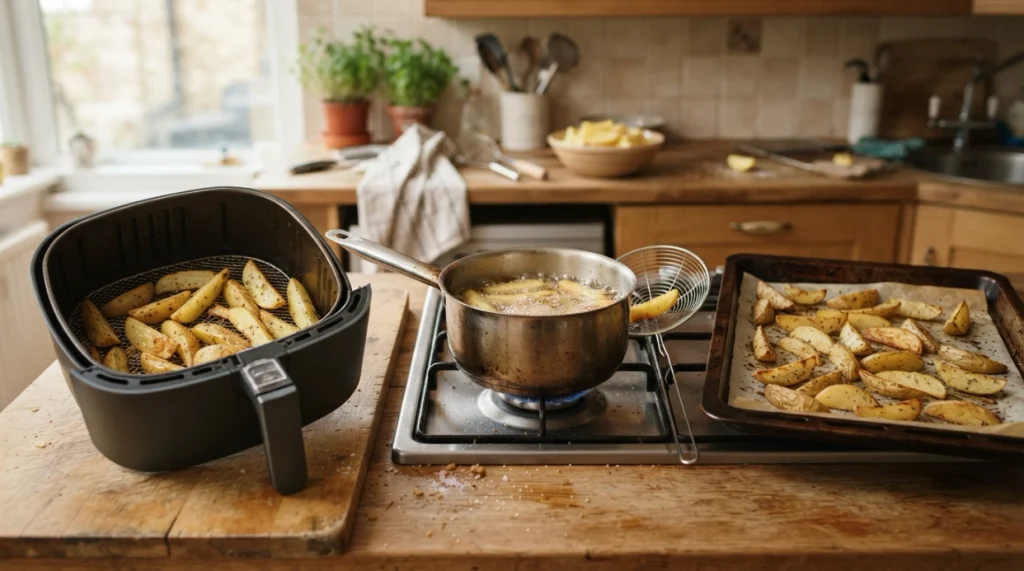
For the same type of food, air frying generally has one major advantage over deep frying: less exposure to cooking oil.
Deep frying surrounds the food with hot oil. Air frying transfers most of its heat through rapidly circulating air.
| Health factor | Air frying | Deep frying | Oven baking |
|---|---|---|---|
| Oil exposure | Usually none or a light coating | Food is submerged in hot oil | Usually none or a light coating |
| Fat absorption | Generally lower than deep frying | Usually higher | Usually low |
| Browning | Fast surface browning | Fast surface browning | Usually slower |
| Acrylamide potential | Possible in browned starchy foods | Possible in browned starchy foods | Possible in browned starchy foods |
| Best use | Crisp food with little added oil | Traditional fried texture | Larger batches and gentler baking |
Research on French fries has found substantially lower fat content in air-fried potatoes compared with conventionally deep-fried versions under controlled conditions.
A separate 2026 study involving reheated crispy pork reported 15.4% less fat with air frying than deep-frying in that particular experiment. Results will vary by recipe and food.
Air frying does not remove the food’s original fat
Put bacon, fatty sausage, or heavily processed chicken into an air fryer and the starting food remains high in fat.
The machine may drain some rendered fat into the basket. That does not transform the food into a low-fat meal.
Lower oil does not always mean low calorie
A food can use little cooking oil and still be calorie-dense. Cheese, pastry dough, breading, sugar, and fatty meat all contribute energy.
I use the air fryer as a substitute for deep frying, not as permission to double the serving size.
For technique-focused comparisons, resources such as Serious Eats and America’s Test Kitchen are useful references for understanding how different cooking methods affect browning and texture.
Section Takeaway: Air frying usually reduces cooking-oil exposure compared with deep frying. The nutritional benefit is greatest when it replaces deep frying rather than simply adding more fried-style foods to your diet.
Does Air Frying Create Acrylamide?
Yes. Air frying can produce acrylamide in certain carbohydrate-rich foods because it uses high temperatures and encourages browning.
Acrylamide forms naturally when some sugars react with the amino acid asparagine during high-temperature cooking.
Which foods are most relevant?
The issue mainly concerns plant foods that brown during cooking. Potatoes and grain-based foods are common examples.
- French fries
- Potato wedges
- Hash browns
- Toast
- Crackers
- Some baked grain products
The U.S. Food and Drug Administration notes that acrylamide is associated with frying, roasting, and baking. It is not unique to air fryers.
Laboratory animal research has raised concern about high acrylamide exposure. Human dietary risk at the much lower levels found in foods remains less certain.
Does an air fryer always produce less acrylamide?
No. Research results differ depending on the food, temperature, preparation method, and cooking duration.
One earlier potato study reported a large reduction in acrylamide with air frying compared with conventional deep frying. That finding helped fuel the idea that air frying always produces less.
However, newer research makes the picture more complicated. A study comparing air-fried, deep-fried, and oven-fried potatoes found no statistically significant difference between cooking methods under its tested conditions.
A 2026 study on reheated hash browns also found higher acrylamide concentrations with the tested air-based methods than with its oil-based methods.
That does not mean air frying is worse overall. It means acrylamide formation cannot be predicted from the appliance name alone.
Color is a useful practical signal
The Food and Drug Administration recommends cooking cut potato products to a golden-yellow color rather than dark brown when trying to reduce acrylamide formation.
Longer cooking and higher temperatures generally promote more formation in susceptible foods.
- Aim for golden: Stop fries and potato wedges before they become deeply brown.
- Avoid burnt edges: Remove very dark pieces instead of eating them routinely.
- Soak fresh potatoes: Soaking cut potatoes in water for 15 to 30 minutes can reduce acrylamide formation.
- Dry before cooking: Blot soaked potatoes before placing them in the air fryer.
- Do not overcook: Extra browning is not automatically better.
For baking applications, I take the same approach with cookies and pastry edges. I want them cooked and pleasantly browned, not unnecessarily dark.
Section Takeaway: Air frying can form acrylamide, especially in potatoes and grain-based foods. Temperature, cooking time, moisture, preparation, and final browning level matter more than simply choosing an air fryer.
What Makes Air-Fried Food Less Healthy?
The biggest problems usually come from the ingredients and eating pattern rather than circulating hot air.
These are the factors I would check first.
Highly processed frozen foods
Frozen fries, nuggets, pizza snacks, breaded cheese, and similar foods are convenient. Many are also heavily processed before they reach your air-fryer basket.
Check the Nutrition Facts label instead of assuming “air fried” means light.
Too much sodium
An air fryer cannot remove salt already mixed into breading, seasoning blends, sauces, or processed meat.
Using herbs, pepper, garlic, paprika, lemon, and other seasonings can help reduce your dependence on extra salt.
Heavy breading and refined carbohydrates
A thick breaded coating may add refined flour and calories even when very little oil is used.
A lighter coating can still provide crispness because strong convection airflow dries the surface efficiently.
Repeated heavy charring
Crisp is not the same as burnt. I stop cooking once the surface reaches the texture I want.
Continually pushing starchy food toward dark brown also increases acrylamide concerns.
Oversized portions
Air-fried food can feel easier to justify because it contains less cooking oil. That health halo can make portion sizes creep upward.
A balanced plate still matters more than the appliance used to cook one part of it.
How Can You Make Air-Fried Food Healthier?
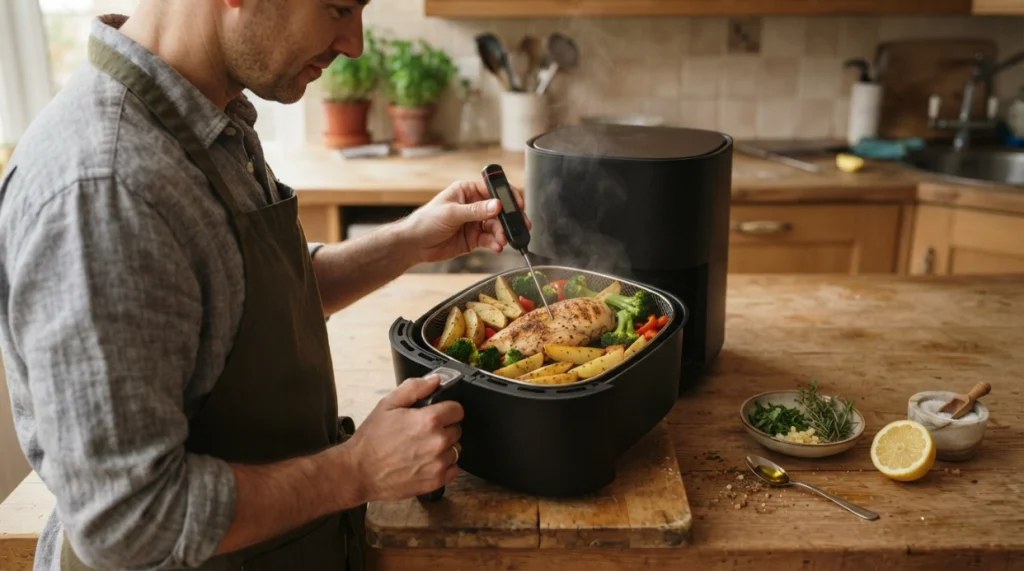
Start with better ingredients and use the air fryer to make those foods more enjoyable. That gives you more benefit than chasing one perfect temperature setting.
1. Build meals around minimally processed foods
Vegetables, potatoes, fish, chicken, tofu, beans, and homemade foods give you more control over oil, salt, breading, and portion size.
Frozen convenience foods can still fit occasionally. I just do not treat them as nutritionally identical to fresh ingredients.
2. Use oil deliberately
You usually need only enough oil to help browning and prevent dryness. Pouring excess oil into the basket defeats one of the air fryer’s main advantages.
- Brush food lightly with oil.
- Use a measured teaspoon instead of free-pouring.
- Skip extra oil when the food already contains plenty.
- Choose unsaturated cooking oils when they suit the recipe.
3. Do not chase maximum crispness
Many air fryers can run around 400°F, or about 204°C. You do not need maximum heat for every recipe.
Reducing temperature slightly can help when the outside browns long before the center finishes.
4. Give food enough basket space
Overcrowding blocks airflow. Food then cooks unevenly, which may tempt you to keep heating the whole batch until the pale pieces finally brown.
Cook in smaller batches when necessary. Shake or turn food so different surfaces meet the hot airflow.
5. Treat frozen foods differently from fresh foods
Many frozen fries, nuggets, and snacks already contain oil. Adding another coating is often unnecessary.
Read the package directions first, then adjust based on your air fryer because basket size and fan strength vary.
6. Use temperature, not time alone, for meat
Air fryers can brown the outside of chicken or meat before the center reaches a safe temperature. A food thermometer gives you a better answer than appearance.
Pro tip: Check FoodSafety.gov’s verified internal-temperature guidance for meat, poultry, seafood, leftovers, and casseroles instead of relying only on air-fryer cooking time.
7. Use the appliance for more than fried-style snacks
One of my favorite ways to think about the appliance is as a small convection oven. That opens the door to roasted vegetables, fish, stuffed peppers, baked oats, and small-batch baking.
For air-fryer baking ideas, King Arthur Baking is a useful technique reference because air movement, pan size, and browning matter just as much as temperature.
- Breakfast: Baked oats, egg dishes, or reheated whole-grain items.
- Lunch: Vegetables, tofu, chicken, or fish.
- Snacks: Chickpeas, vegetables, or homemade potato wedges.
- Baking: Small cakes, cookies, pastries, and reheated baked goods.
Section Takeaway: The healthiest air-fryer strategy is simple: start with nutritious ingredients, control added oil and sodium, avoid excessive browning, and verify safe internal temperatures when cooking meat or poultry.
Frequently Asked Questions
Is eating air-fried food every day unhealthy?
Not necessarily. Daily air-fryer use can fit a balanced diet if you mostly cook vegetables, lean proteins, potatoes, whole foods, and minimally processed ingredients rather than relying on breaded frozen snacks at every meal.
Are air-fried French fries healthy?
Air-fried fries can contain less cooking oil than deep-fried fries, especially when made from fresh potatoes. They are still a starchy food, and portions, salt, added oil, and excessive browning all affect the final nutritional picture.
Does air frying destroy nutrients?
Any cooking method can change some nutrients. Heat-sensitive nutrients may decline, while cooking can also improve texture, digestibility, and availability of certain compounds, so it is too simplistic to say air frying “destroys” a food’s nutrition.
Is air frying healthier than baking?
Neither method is automatically healthier. Both use hot circulating or surrounding air, and both can work with little oil. Air fryers usually cook smaller portions faster, while ovens handle larger batches more easily.
Can air-fried food cause cancer?
It is not accurate to say that air-fried food itself causes cancer. High-temperature cooking of certain starchy foods can form acrylamide, but the Food and Drug Administration notes that human dietary risk at typical food exposure levels remains uncertain.
Should I worry about acrylamide every time I use an air fryer?
No. Focus on practical habits instead of fearing the appliance. Avoid routinely burning starchy foods, aim for golden rather than dark-brown potatoes, vary your cooking methods, and eat a diverse diet.
Is air-fried frozen food healthier than deep-fried frozen food?
It often uses less additional cooking oil, which can be an advantage. However, the original product may still contain substantial sodium, saturated fat, refined flour, or added oil, so check the nutrition label before judging it by cooking method alone.
What Is the Bottom Line?
Air-fried food is not inherently unhealthy. In many situations, an air fryer is a practical way to get crisp texture while using much less cooking oil than deep frying.
The bigger issue is what goes into the basket. Vegetables, homemade potatoes, lean proteins, and lightly seasoned foods can fit comfortably into a balanced eating pattern.
Packaged fries, breaded snacks, processed meats, and sugary pastries do not become health foods simply because they were air fried.
As of 2026, the research also gives us a useful reminder about acrylamide. Air frying can reduce it in some situations, but other studies show that cooking time, temperature, food composition, and browning can change the result.
My practical approach is straightforward: use less oil, avoid unnecessary charring, eat a varied diet, and let the air fryer replace deep frying when it makes sense.
If your air fryer helps you cook more vegetables, lean proteins, and homemade meals with less oil, it can be a useful part of a healthy kitchen.
