
Is Baked or Air Fried Chicken Better?
Quick Answer
Air fried chicken is usually better when you want crispier skin, faster cooking, and smaller portions with little added oil. Baked chicken is often better for large batches, whole chickens, casseroles, and recipes where gentle, even cooking matters more than maximum crispness. Whichever method you choose, chicken should reach a safe internal temperature of 165°F (74°C), following FoodSafety.gov poultry guidance.
Which method wins where?
- Crispiness: Air frying usually creates a drier, crispier exterior because hot air moves rapidly around the chicken.
- Large batches: Baking gives you much more cooking space and works better when feeding several people.
- Cooking speed: An air fryer generally heats quickly and works well for smaller portions.
- Oil use: Both methods can use little oil, so neither requires deep frying.
- Juiciness: Either method can produce juicy chicken when you avoid overcooking it.
- Best overall: Choose air frying for speed and crunch; choose baking for capacity and versatility.
Is baked or air fried chicken better? After using both approaches in everyday cooking, I think the answer depends more on the result you want than on one method being universally superior.
Air fried chicken shines when crispness and convenience matter. Oven-baked chicken becomes the smarter choice when you’re cooking more food or need extra space and flexibility.
In This Guide
- Is Air Fried or Baked Chicken Better Overall?
- How Do Air Frying and Baking Cook Chicken Differently?
- Does Air Fried Chicken Taste Better Than Baked Chicken?
- Is Air Fried Chicken Healthier Than Baked Chicken?
- Is It Faster to Bake or Air Fry Chicken?
- Which Cooking Method Is Best for Different Chicken Cuts?
- Frequently Asked Questions
Is Air Fried or Baked Chicken Better Overall?
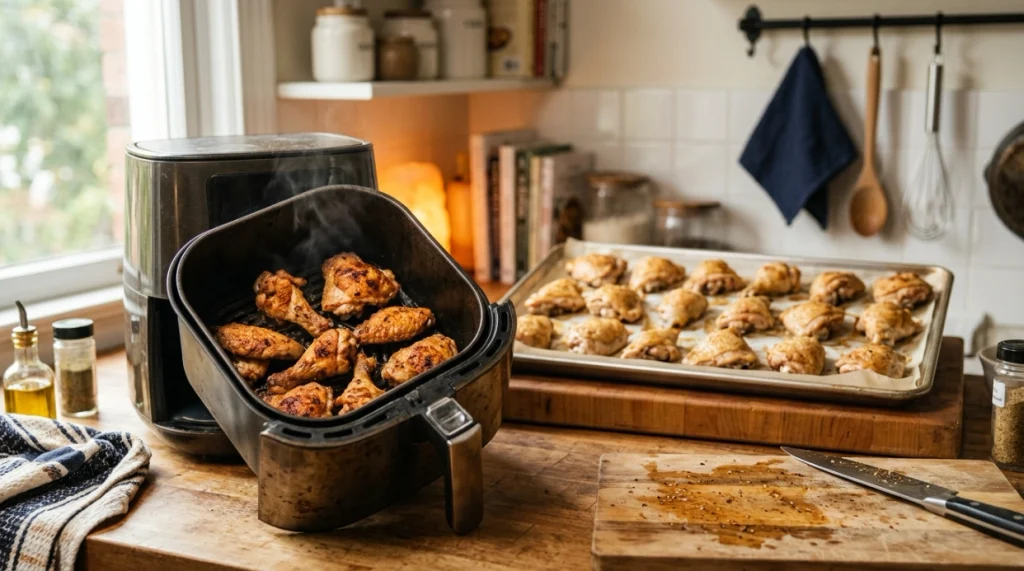
Air fried chicken is better for quick, crispy meals in small batches, while baked chicken is better for capacity and versatility. Neither method automatically produces better chicken in every situation.
In 2026, the fundamental difference remains simple. Air fryers concentrate moving hot air inside a small chamber, while a conventional oven gives you a much larger cooking area.
- Choose an air fryer for wings, drumsticks, thighs, chicken tenders, and a few chicken breasts.
- Choose an oven for large sheet pans, family-size meals, whole birds, casseroles, or chicken cooked with vegetables.
- Choose either method when your priority is avoiding deep frying and minimizing added oil.
I tend to think of the air fryer as the weeknight option. It’s particularly useful when I want browned chicken without heating a full-size oven for a small amount of food.
The oven becomes more practical as the portion grows. Trying to squeeze too much chicken into an air fryer basket defeats one of the appliance’s biggest advantages: strong airflow around the food.
| Factor | Air Fried Chicken | Baked Chicken |
|---|---|---|
| Exterior | Usually browns and crisps quickly | Good browning, but often less intense |
| Capacity | Best for small batches | Better for large batches |
| Preheating | Compact chamber generally heats quickly | Large oven cavity generally takes longer |
| Added oil | Little or none required | Little or none required |
| Safe chicken temperature | 165°F (74°C) | 165°F (74°C) |
| Best use | Quick crispy portions | Family meals and larger recipes |
How Do Air Frying and Baking Cook Chicken Differently?
The biggest difference is airflow. An air fryer surrounds food with rapidly circulating hot air inside a compact cooking chamber, while a standard oven usually relies more heavily on radiant and surrounding heat.
An air fryer is a compact convection-style cooker that uses a fan to circulate heated air rapidly around food. The small chamber and strong airflow help food brown and crisp efficiently.
Consumer Reports describes air frying as a form of convection cooking and notes that the small cooking space concentrates hot air around food. That helps explain why chicken skin can crisp so effectively in the basket.
You can read more about how air fryers cook food and how their design differs from a standard oven.
What happens inside an air fryer?
Hot air moves around the chicken and across its exposed surface. Moisture on the exterior evaporates, helping the skin or breading dry and brown.
- Perforated baskets let air reach more of the chicken.
- A compact chamber keeps food close to the heat source.
- Fast-moving air promotes browning on exposed surfaces.
- Leaving space between pieces improves circulation.
What happens when chicken is baked?
A standard oven has a much larger chamber. Air moves less aggressively unless you’re using a convection setting.
That isn’t necessarily a disadvantage. The larger space provides room for sheet pans, baking dishes, vegetables, sauces, and bigger pieces of chicken.
Convection mode narrows the difference. America’s Test Kitchen reports that convection roasting can produce faster cooking and stronger browning than standard oven cooking, including with roast chicken.
Their convection oven guidance is useful when comparing a convection oven with an air fryer’s forced-air approach.
Does Air Fried Chicken Taste Better Than Baked Chicken?
Air fried chicken usually has the advantage when your definition of “better” means crispy skin or breading. Baked chicken can still brown well, but an air fryer concentrates airflow around a smaller amount of food.
That difference becomes obvious with skin-on thighs and wings. A dry exterior can turn noticeably crisp without needing to submerge the chicken in oil.
Why air fried chicken gets crispy
- Fast airflow: Moving air removes surface moisture efficiently.
- Small chamber: Food stays close to intense circulating heat.
- Perforated basket: Heat can reach several sides of each piece.
- Small batches: Proper spacing exposes more surface area.
King Arthur Baking describes air fryers as small convection ovens with high-powered fans and compact chambers. That same design that crisps baked goods can help chicken develop a stronger exterior crust.
Their explanation of how air fryer convection works is helpful even though the examples focus mainly on baking.
Does baking make chicken juicier?
Not automatically. Juiciness depends heavily on the chicken cut, thickness, temperature, and how far you cook it.
A chicken breast can dry out in either appliance when overcooked. Dark meat such as thighs tends to be more forgiving because of its higher fat content.
- Use similarly sized pieces so they finish together.
- Check thick pieces separately instead of trusting appearance.
- Avoid overcrowding an air fryer basket.
- Let very hot chicken rest briefly before cutting into it.
Pro tip: Use a food thermometer in the thickest part of the chicken and follow verified USDA/FoodSafety.gov temperature guidance rather than relying on cooking time, color, or crispness alone.
Is Air Fried Chicken Healthier Than Baked Chicken?
Air fried and baked chicken can both be healthy cooking choices because neither method requires deep frying. The ingredients, chicken cut, skin, breading, sauces, and amount of added oil matter more than the appliance name.
It’s easy to assume that “air fried” automatically means lower calorie. That isn’t always true.
The recipe matters more than the machine
Consider two chicken breasts of the same size. If one is lightly seasoned and baked while the other is heavily breaded and coated with oil before air frying, the baked version could easily contain less added fat.
- Skinless chicken: Usually contains less fat than comparable skin-on chicken.
- Breading: Adds carbohydrates and calories regardless of the appliance.
- Added oil: Raises calorie content whether you bake or air fry.
- Sauces: Sweet or creamy sauces can significantly change the finished dish.
- Portion size: Still matters with either cooking method.
The strongest health advantage over traditional deep frying is that both methods can cook chicken without immersing it in a large amount of oil. You can often get good browning with a thin coating or no added oil, depending on the recipe.
What about food safety?
The cooking appliance doesn’t change the minimum safe temperature for chicken. FoodSafety.gov lists 165°F (74°C) for chicken, turkey, and other poultry.
Use a digital food thermometer at the thickest section. Avoid touching bone when checking a large bone-in piece.
Pro tip: Cooking time is only a guide. Verify poultry doneness with an internal-temperature reading before serving.
Is It Faster to Bake or Air Fry Chicken?
Air frying is generally more convenient for a small amount of chicken because the cooking chamber is compact and usually heats quickly. Baking can become more efficient when you’re cooking several portions at once.
This is where capacity changes the answer. Four chicken pieces that fit comfortably in an air fryer may be convenient, while twelve pieces might require several separate batches.
When the air fryer saves time
- Cooking one or two chicken breasts
- Making a small batch of wings
- Reheating previously cooked chicken
- Cooking a few drumsticks or thighs
- Avoiding a long full-size oven preheat
I especially like this approach when the rest of dinner is already finished. A small amount of chicken can cook without tying up the main oven.
When the oven is more convenient
- Feeding a family or group
- Cooking chicken with potatoes or vegetables
- Roasting a whole chicken
- Using a large casserole or roasting pan
- Preparing several servings at the same time
Batch cooking is the hidden weakness of smaller basket air fryers. Overcrowding reduces airflow, so squeezing in extra chicken can work against the crisp texture you’re trying to create.
A standard oven lets you spread pieces across a large tray. For meal prep or entertaining, that extra space can matter more than a faster individual batch.
Which Cooking Method Is Best for Different Chicken Cuts?
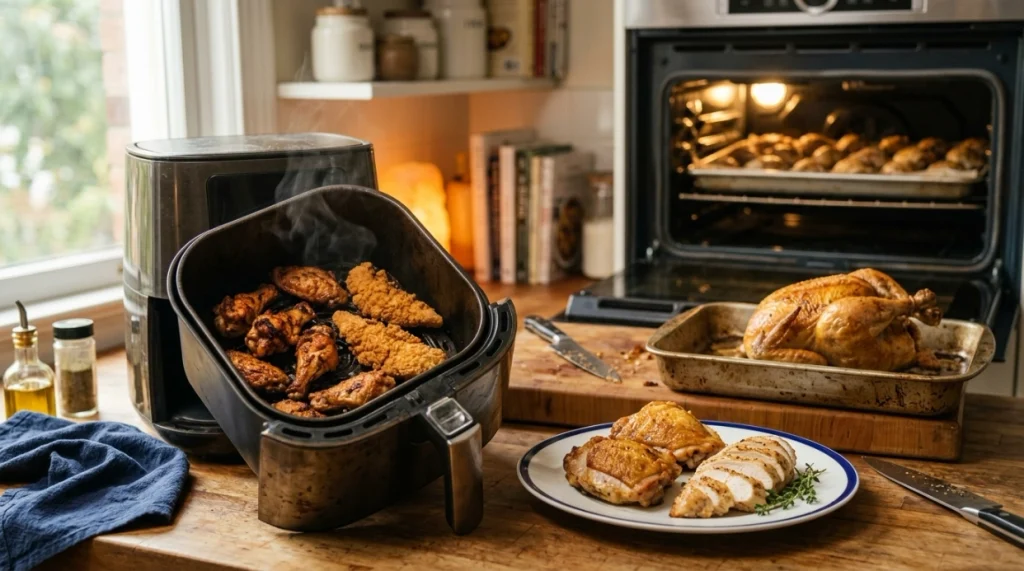
Air frying works especially well with smaller pieces that benefit from crisp surfaces, while baking is easier for large cuts and high-volume meals. The best choice also depends on whether the chicken has skin, breading, or sauce.
Chicken wings
I would usually choose the air fryer for a small batch of wings. Their high surface-area-to-meat ratio suits concentrated convection heat.
Leave enough room for air to circulate. Cook in batches instead of stacking wings tightly.
Chicken thighs
Both methods are excellent. Air frying is particularly useful for skin-on thighs when crispy skin is the priority.
Baking becomes more convenient when you need a tray of six, eight, or more thighs. It’s also easier when adding vegetables or cooking the thighs in sauce.
Chicken breasts
Either appliance works, but thickness matters. Large breasts take longer for heat to reach the center, so watch the exterior while waiting for safe internal doneness.
For quicker, more predictable cooking, try pieces with similar thickness. Uneven breasts may benefit from gentle flattening before seasoning.
Chicken tenders
The air fryer is a strong choice for tenders because they’re small and cook quickly. Breaded tenders also benefit from moving hot air around the coating.
A large sheet pan is still easier when cooking many servings. Don’t sacrifice proper basket spacing just to avoid a second batch.
Whole chicken
I prefer the oven when size or clearance is questionable. A full-size oven provides room around the bird and makes roasting pans easier to handle.
Some large air fryers can accommodate small whole chickens. Always follow the appliance’s capacity instructions and keep food clear of the heating element.
| Chicken Type | Good First Choice | Why |
|---|---|---|
| Wings | Air fryer | Excellent airflow and crisping for small batches |
| Skin-on thighs | Air fryer or oven | Air fryer for crispness; oven for volume |
| Breasts | Either | Thickness and final temperature matter most |
| Tenders | Air fryer | Small size suits quick convection cooking |
| Large batch | Oven | More usable cooking area |
| Whole chicken | Oven | More room and easier roasting-pan use |
My simple rule: use the air fryer when surface crispness matters most, and use the oven when cooking space matters most.
Frequently Asked Questions
Is air fried chicken as healthy as baked chicken?
It can be. Both air frying and baking can prepare chicken with little added oil. The nutritional difference depends mainly on the chicken cut, skin, breading, sauce, oil quantity, and portion size rather than which appliance you use.
Does air fried chicken have more calories than baked chicken?
Not necessarily. Identical chicken prepared with identical ingredients should remain broadly similar in calorie content. Calories can differ when one recipe uses more oil, breading, skin, sugary glaze, or another calorie-dense ingredient.
Does an air fryer make chicken crispier than an oven?
It often does, especially with smaller portions. The compact chamber, fan-driven airflow, and perforated basket help remove surface moisture and brown exposed areas efficiently.
Can I cook chicken without oil in an air fryer?
Yes, many chicken cuts can cook without added oil, particularly skin-on pieces that already contain fat. A small amount of oil can still improve browning or help dry seasonings adhere to lean chicken.
What temperature should cooked chicken reach?
FoodSafety.gov lists 165°F (74°C) as the safe minimum internal temperature for chicken and other poultry. Measure the thickest section with a food thermometer rather than judging doneness by color, texture, or cooking time alone.
Is an air fryer just a small convection oven?
An air fryer uses convection principles, but its compact chamber, powerful fan, and basket design concentrate airflow around food. Those differences can make it faster and more effective at crisping small portions than many full-size ovens.
Should I air fry or bake chicken for meal prep?
Baking is often easier for meal prep because a sheet pan can hold more chicken at once. Air frying can work well when preparing only a few portions or when crisp texture is more important than batch size.
Final takeaway: Air fried chicken is my first choice for small, crispy, quick-cooking portions. Baked chicken makes more sense for bigger meals, whole birds, and recipes that need the space of a full-size oven.
Whichever method you choose, don’t judge chicken by appearance alone. Use a food thermometer, avoid overcrowding, and match the appliance to the amount of chicken you’re cooking.
