
Is Grilling Better Than Air Frying? A Practical 2026 Comparison
Quick Answer
Grilling is not automatically better than air frying. Grilling is usually better for smoky flavor, searing, and cooking larger portions, while air frying is often better for quick cooking, crisp texture, easy cleanup, and using little added oil. An air fryer works as a compact convection cooker, which Consumer Reports explains in its air fryer guidance.
The main differences
- Flavor: A grill can create smoke, flame-kissed aromas, grill marks, and deeper charred flavors.
- Crispiness: An air fryer excels at evenly crisping fries, wings, breaded foods, vegetables, and leftovers.
- Oil use: Air frying usually needs little or no added oil for foods that already contain some fat.
- Capacity: A full-size grill normally handles more food at once than a basket-style air fryer.
- Convenience: Air fryers are generally easier for quick weekday meals and small portions.
- Best choice: Choose the cooking method according to the food and the result you want.
Simple rule
- Use the grill when you want smoke and strong browning. Use the air fryer when you want fast, controlled crisping with less mess.
I use grilling and air frying for different jobs because they do not create exactly the same result. Trying to declare one method universally better misses the main point.
The important question is what you are cooking and what texture, flavor, capacity, and convenience you need. Here is how the two methods compare in a real home kitchen.
In This Guide
Is Grilling Better Than Air Frying Overall?
No single method wins every category. Grilling performs better when smoke, char, direct heat, and cooking capacity matter most.
Air frying becomes more attractive when you want crisp food quickly without setting up an outdoor grill. It also gives you more control for small portions.
| Feature | Grilling | Air Frying |
|---|---|---|
| Heat style | Strong radiant and direct heat | Rapidly circulated hot air |
| Signature result | Searing, char, grill marks, smoky notes | Even browning and crisp surfaces |
| Added oil | Usually low, depending on marinade and food | Usually little or none |
| Batch size | Usually larger | Limited by basket or cooking chamber |
| Setup | More setup, especially charcoal grilling | Plug in, set temperature, and cook |
| Cleanup | Grates, grease, ash, or drip trays may need cleaning | Usually basket and crisper tray |
| Weather dependence | Outdoor grilling can depend on conditions | Designed for indoor countertop use |
| Best for | Steaks, burgers, kebabs, larger vegetables | Fries, wings, vegetables, frozen foods, leftovers |
I think of the grill as a flavor-producing tool and the air fryer as a fast crisping tool. There is overlap, but their strengths remain different.
For a weekend cookout, I would want the grill’s capacity and intense surface heat. For a small dinner on a Tuesday night, the air fryer usually makes more practical sense.
How Do Grilling and Air Frying Cook Food Differently?
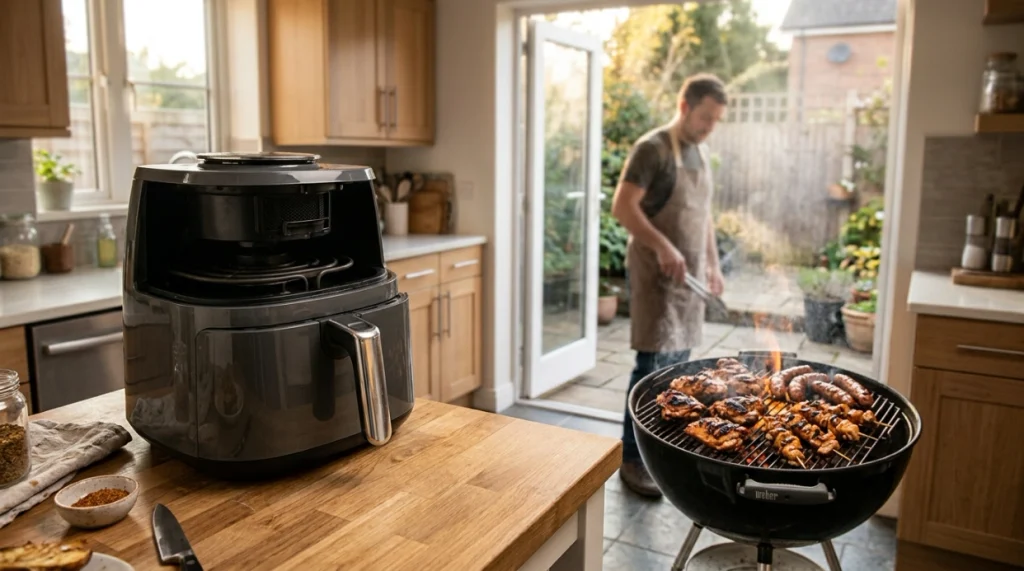
Grilling relies heavily on radiant heat and contact with a hot grate. Air frying cooks mainly through powerful convection, meaning hot moving air transfers heat around the food.
Definition: An air fryer is a compact convection appliance that uses a heating element and high-powered fan to move hot air quickly around food.
What happens inside an air fryer?
The heating element warms the air while a fan circulates it through the compact chamber. A perforated basket or crisper tray helps expose more of the food to that moving air.
- Surface moisture escapes: Drying helps foods become crisp.
- Browning develops: High surface temperatures create golden color and roasted flavor.
- Fat can drain: Rendered fat may fall below the crisper tray.
- Small batches cook efficiently: The compact chamber has less space to heat than a full oven.
This is why foods such as frozen fries, breaded chicken, Brussels sprouts, and leftover pizza suit air frying well. Strong airflow helps dry their surfaces while they heat.
Air fryers can also bake. King Arthur Baking’s air fryer guidance explains that the powerful fan and compact chamber make air fryers effective for small baked goods and crisp textures.
What happens on a grill?
A grill exposes food to strong heat from below, although the exact mechanism depends on charcoal, gas, or electric equipment. Food can also pick up flavor from smoke and vaporized drippings.
- Direct grilling: Food sits over the main heat source for fast browning and searing.
- Indirect grilling: Food cooks away from the strongest heat, more like roasting.
- Grate contact: Hot metal produces localized browning and familiar grill marks.
- Smoke exposure: Charcoal, wood, and burning drippings can change aroma and flavor.
The grill therefore creates sensory effects that a standard air fryer cannot fully copy. An appliance’s “grill” preset does not automatically reproduce cooking over flame or charcoal.
Which Gives Better Flavor and Texture?
Grilling usually has the advantage when you want smoky, flame-kissed flavor. Air frying often has the advantage when you want a consistently dry and crisp exterior.
Grilling creates deeper roasted and smoky notes
Think about a burger, steak, corn cob, or kebab hitting a hot grill grate. The intense heat browns the outside quickly and creates flavors associated with outdoor cooking.
A charcoal or wood-fired grill adds another dimension because smoke interacts with the food. A standard air fryer cannot produce that same combustion-based flavor.
- Steaks: Grilling makes it easier to develop a dark exterior while controlling the center.
- Burgers: Direct heat gives the patty a distinctive grilled surface.
- Corn: Grilling can blister kernels and add light charring.
- Kebabs: Exposed edges brown while vegetables and meat cook together.
Air frying creates more controlled crispness
An air fryer surrounds smaller foods with fast-moving hot air. That makes it especially useful when you want many exposed surfaces to brown.
This difference is obvious with fries and wings. A grill can brown them, but an air-fryer basket is built around airflow reaching several sides.
- French fries: Airflow helps dry and crisp their outer surfaces.
- Chicken wings: Rendered fat can drain while the skin browns.
- Breaded foods: Dry convection heat can crisp coatings without deep frying.
- Roasted vegetables: Small pieces brown quickly when the basket is not overcrowded.
- Leftovers: Pizza and fried foods can regain texture that a microwave tends to soften.
Basket space matters. Pack food tightly and you block the airflow that makes an air fryer useful.
I prefer leaving visible gaps around foods that need crisp edges. Working in two smaller batches often gives a better surface than piling everything into one crowded basket.
Is Grilling or Air Frying Healthier?
Neither cooking method is automatically healthier in every situation. The ingredients, added fats, portion size, temperature, and degree of charring all matter.
Air frying can reduce the need for added cooking oil
Air frying does not require food to sit in a large volume of cooking oil. Many frozen foods and naturally fatty ingredients need little additional fat.
That does not make every air-fried food nutritious. Air-frying a highly processed food does not change its basic ingredients, sodium, or nutritional profile.
- Use oil intentionally: A thin coating can encourage browning without soaking the food.
- Choose whole foods: Vegetables, potatoes, fish, and lean proteins work well.
- Watch coatings: Heavy breading and sugary sauces can change the nutritional picture.
- Think beyond calories: Overall diet quality matters more than the appliance alone.
Grilling can also be a low-oil cooking method
You do not need to deep-fry food to grill it. Lean meat, seafood, vegetables, and fruit can all cook with modest amounts of added fat.
However, heavily charring meat is worth avoiding. The National Cancer Institute explains that high-temperature cooking of muscle meats can produce heterocyclic amines, while smoke from fat dripping onto flame can contribute to polycyclic aromatic hydrocarbons.
NCI’s guidance on high-temperature meat cooking recommends steps such as avoiding prolonged direct exposure to open flame and removing heavily charred portions.
- Avoid excessive charring: Dark grill marks are not a reason to burn the entire surface.
- Turn food regularly: Frequent turning can reduce prolonged exposure to intense heat.
- Use indirect heat: Thick foods can finish away from direct flame.
- Trim flare-up risks: Large amounts of dripping fat can feed flames.
Food safety matters with both methods
Color and cooking time are not dependable ways to confirm that raw meat is safe. A food thermometer gives you a more useful check.
- Poultry: 165°F (74°C).
- Ground meats: 160°F (71°C).
- Beef, pork, lamb, and veal steaks, chops, and roasts: 145°F (63°C), followed by a three-minute rest.
- Fish: 145°F (63°C), or follow current official guidance for the specific seafood.
Pro tip: Always confirm current safe minimum temperatures with FoodSafety.gov’s internal-temperature guidance instead of relying only on cooking time.
Section Takeaway: Air frying can make low-oil cooking convenient, while grilling can also fit a balanced diet. Ingredients and cooking technique matter more than simply labeling one appliance “healthy.”
Which Method Is Faster and Better for Different Foods?
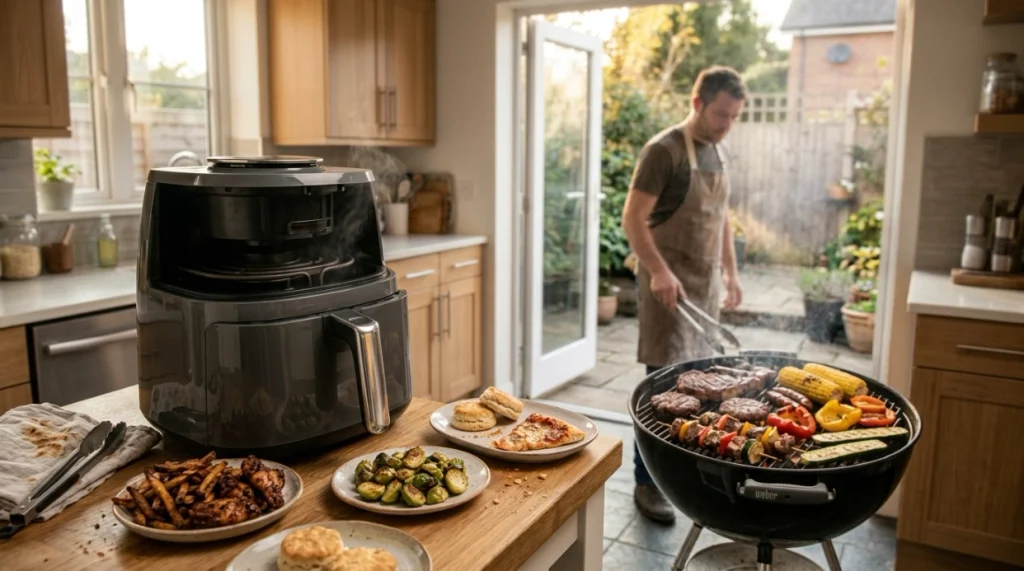
For small everyday portions, an air fryer is usually the more convenient appliance. A grill becomes more efficient when you need cooking space or want flavors produced by intense direct heat.
When an air fryer makes more sense
- Frozen snacks: Fries, nuggets, fish portions, and similar foods crisp quickly.
- Chicken wings: Air circulation works well around their irregular surfaces.
- Roasted vegetables: Broccoli, cauliflower, Brussels sprouts, and potatoes suit dry convection heat.
- Small fish fillets: The compact chamber makes quick meals practical.
- Leftovers: Pizza, fries, and breaded foods can regain a dry exterior.
- Small baked goods: Cookies, biscuits, rolls, and some pastries can fit well.
Preheating requirements vary by model and recipe. Some foods benefit from beginning in a hot cooking chamber, while others can start cold.
Another advantage is repeatability. Set the temperature and timer, then shake or turn the food when the recipe calls for it.
When grilling makes more sense
- Steaks and chops: Direct heat can produce powerful browning.
- Burgers: Grills handle several patties at once and create familiar grilled flavor.
- Kebabs: Meat and vegetables can brown directly over the heat.
- Whole vegetables: Corn, peppers, zucchini, onions, and eggplant develop attractive blistering.
- Large batches: A full grill grate offers more working area than most air-fryer baskets.
- Outdoor cooking: Heat, smoke, and cooking odors stay outside.
What about energy and cleanup?
A compact air fryer only heats a small cooking chamber, which can make it practical for small meals. Exact energy use depends on appliance wattage, cooking time, grill fuel, and batch size.
Cleanup usually favors the air fryer for everyday cooking. Most of my attention goes to the removable basket and crisper tray rather than grill grates and a larger cooking chamber.
| Food | Why Air Fry It? | Why Grill It? |
|---|---|---|
| Chicken wings | Even crisping and fat drainage | Smoke and flame-grilled flavor |
| Steak | Controlled indoor cooking | Strong searing and classic grill flavor |
| French fries | Excellent airflow around small pieces | Usually less convenient unless using a tray |
| Vegetables | Fast roasting and crisp edges | Blistering, grill marks, and smoke |
| Burgers | Easy indoor option for a small batch | Better capacity and grilled character |
| Cookies or biscuits | Useful for small-batch baking | Not normally the simplest choice |
Section Takeaway: Air fryers shine for small, quick, crispy meals. Grills shine when capacity, searing, smoke, and outdoor cooking are part of the goal.
Frequently Asked Questions
Does grilled food taste better than air-fried food?
Grilled food often has a stronger roasted or smoky flavor because direct heat and smoke can affect the surface. Air-fried food usually offers more uniform crispness, so the better taste depends on whether you value smoky flavor or a crisp exterior.
Is air frying healthier than grilling?
Not automatically. Air frying can reduce the need for added oil, while grilling can also cook foods with little added fat. Food choice, sauces, portion size, cooking temperature, and excessive charring matter more than the cooking appliance alone.
Can an air fryer replace a grill?
An air fryer can handle many foods people grill, including chicken, burgers, vegetables, and fish. However, a standard air fryer cannot fully reproduce the smoke, flame exposure, cooking area, or direct grate searing of an outdoor grill.
Can I get grill marks in an air fryer?
Some air fryers include ridged grill plates that create browned contact lines. Those marks may look similar to grill marks, but they do not automatically provide the smoke or flame-produced flavors associated with traditional grilling.
Which is better for chicken wings?
Air frying is convenient when your priority is crisp skin, simple cleanup, and a small batch. Grilling is attractive when you want smoky flavor and have enough grate space to cook more wings at the same time.
Which method is better for steak?
Grilling has clear advantages when you want intense exterior browning and traditional grilled flavor. An air fryer can still cook steak indoors, but its rapidly moving hot air creates a different surface and flavor profile.
Is an air fryer faster than a grill?
For small portions, an air fryer can be faster to set up because there is no charcoal to light or large grill chamber to heat. A grill may become more efficient when cooking a large batch because it offers substantially more cooking area.
Which Method Should You Choose?
Choose an air fryer when you want speed, crispiness, small-batch convenience, and straightforward cleanup. It is especially practical for frozen foods, vegetables, wings, leftovers, and quick indoor meals.
Choose a grill when you want searing, smoke, char, larger cooking capacity, or an outdoor cooking experience. Steaks, burgers, kebabs, corn, and larger batches are natural candidates.
- Choose air frying for: Fast weeknight meals, crisp textures, leftovers, small portions, and indoor cooking.
- Choose grilling for: Smoky flavor, strong searing, cookouts, larger quantities, and foods that benefit from direct heat.
- Use both when possible: They solve different cooking problems rather than replacing each other perfectly.
As of 2026, I would not treat grilling versus air frying as an either-or decision. The better method changes with the food in front of you.
If I want crisp fries with minimal fuss, I reach for an air fryer. If I want a steak with the character of an outdoor grill, I choose the grill.
