
How to Fix Over-Proofed Dough Before It Goes to Waste

Few things are more frustrating than watching a beautiful dough turn soft, slack, and over-puffy right when you were ready to bake. The good news: if you catch it in time, you can often fix over proofed dough well enough to still get a respectable loaf, pizza, or enriched bake.
The key is to diagnose the problem honestly. Overproofed dough has already spent too long fermenting, so the gluten network is weaker and the dough can’t hold gas as well as it should. That means the rescue is not about “undoing” the mistake. It’s about deciding whether the dough still has enough structure to be reshaped, chilled, and baked with some success.
Here’s the practical way to think about it:
- Slightly overproofed dough can often be rescued.
- Very overproofed dough may still bake, but the result is usually flatter and denser.
- Collapsed, fragile dough is often better repurposed than forced into a tall loaf.
If you need a companion guide for the opposite problem, our article on under-proofed dough is a helpful comparison.
What to Do Right Now: The Fastest Rescue Options
If you are standing in front of overproofed dough right now, use this quick decision tree:
- If it is only slightly overproofed and still holds shape: chill it if you need to buy time, or bake soon if it is already close to ready.
- If it is overproofed but still elastic enough to handle: deflate it gently, reshape it, and give it only a short second proof.
- If it has collapsed, spreads like batter, or tears easily: repurpose it instead of trying to save it as a loaf.
That is the simplest triage rule: bake now, deflate and reshape, or repurpose.
A brief cold rest can help when the dough is only a little ahead of schedule, especially if you need a short delay before shaping or baking. But chilling will not meaningfully restore dough that has already lost most of its structure.
How to Tell If Dough Is Overproofed
The fastest way to judge dough is to combine sight, touch, and the fingertip test. No single cue is perfect on its own, but together they give you a much clearer answer.
Signs that point to overproofing
Overproofed dough often looks overly expanded and fragile. It may feel very airy, slack, and delicate when you touch it. If you gently press it and the indentation stays behind with little or no spring-back, that is a strong sign the dough has gone too far.
The poke test is useful here. Some bakers use a fingertip press for a couple of seconds and watch how quickly the dough springs back, but the exact timing and interpretation can vary by dough type and source. Use it as a guideline alongside visual cues, not as a universal rule.
A few practical signs to watch for:
- The dough looks very puffy but feels weak.
- It spreads out instead of holding shape.
- It deflates easily when handled.
- The surface may look smooth but overly stretched.
- In a loaf pan, it may rise very high and then begin to slump.
Overproofed vs. underproofed
These two problems can look similar to beginners because both may involve dough that seems “not quite right.” The difference is in the dough’s response.
- Underproofed dough usually feels tighter and springs back quickly.
- Overproofed dough feels fragile and leaves a dent that does not recover well.
If you’re unsure, err on the side of caution and handle it gently. A dough that is only slightly overproofed may still be rescued. A dough that is badly overproofed may need a different plan.
What Causes Overproofing and Why It Matters
Overproofing usually happens for one of three reasons: too much time, too much warmth, or too much yeast for the schedule you gave the dough.
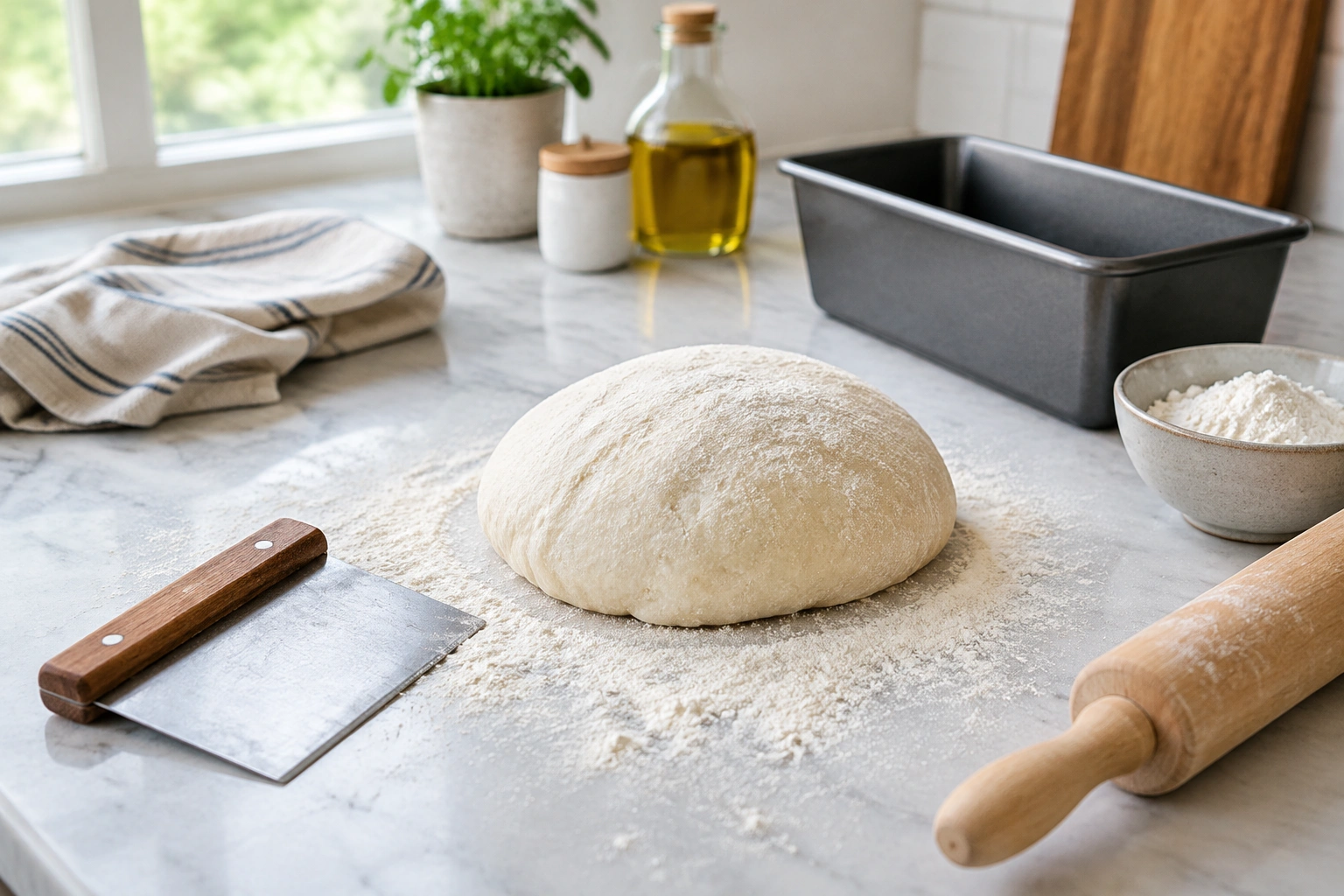
A warm kitchen can speed fermentation. So can a dough that was left out longer than expected, or one that was proofed by the clock instead of by the dough’s actual condition. Enriched doughs can be especially tricky because sugar, butter, milk, and eggs change fermentation behavior and can make the dough feel softer and more delicate.
Why does this matter? Because the gluten network is what holds the dough’s structure. When fermentation goes too far, that network weakens. Gas production may continue, but the dough loses the strength to trap it well. The result is less oven spring, a flatter shape, and often a crumb with large irregular holes mixed with dense spots.
That doesn’t mean the bread will be inedible. It means the final bake may be less lofty and less even than you planned.
What You Need Before You Try to Save It
Before you rescue the dough, set up your workspace so you can move efficiently. The goal is to handle the dough just enough to restore structure without tearing it apart.
Have these ready:
- A lightly floured work surface
- A bench scraper or dough scraper
- The loaf pan, pizza tray, or basket you plan to use
- A little extra flour for handling, not for burying the dough
- A cooler spot in the kitchen, or the refrigerator if you need to slow it down
If the dough is already soft and fragile, rushing around the kitchen only makes things worse. A calm, organized setup helps you make better decisions.
Step-by-Step: How to Rescue Over-Proofed Dough
Here is the most practical rescue method for bread-style dough and many pizza doughs.
1. Remove the dough carefully from its proofing container
Lift it out gently so you don’t tear the surface. If it is sticking, use a scraper rather than pulling on it.
2. Degas it enough to rebuild structure
Modernist Cuisine describes pressing the dough down firmly to degas it. For most home bakers, that means deflating the dough in a controlled way rather than smashing it flat. You are trying to remove excess gas and reset the structure, not punish the dough.
3. Choose the right rescue path
At this point, decide which of these applies:
- Bake now if the dough is fragile but still coherent and already close to ready.
- Deflate and reshape if the dough still has enough elasticity to support a new form.
- Repurpose if the dough is so weak that it will not hold tension or shape.
For bread dough, a brief deflate and reshape can work well when the dough still feels elastic. For pizza dough, a light knock-back is often enough before a short rest and stretch. If the dough is badly overproofed, though, more handling usually makes it worse.
4. Reshape with tension only if the dough can support it
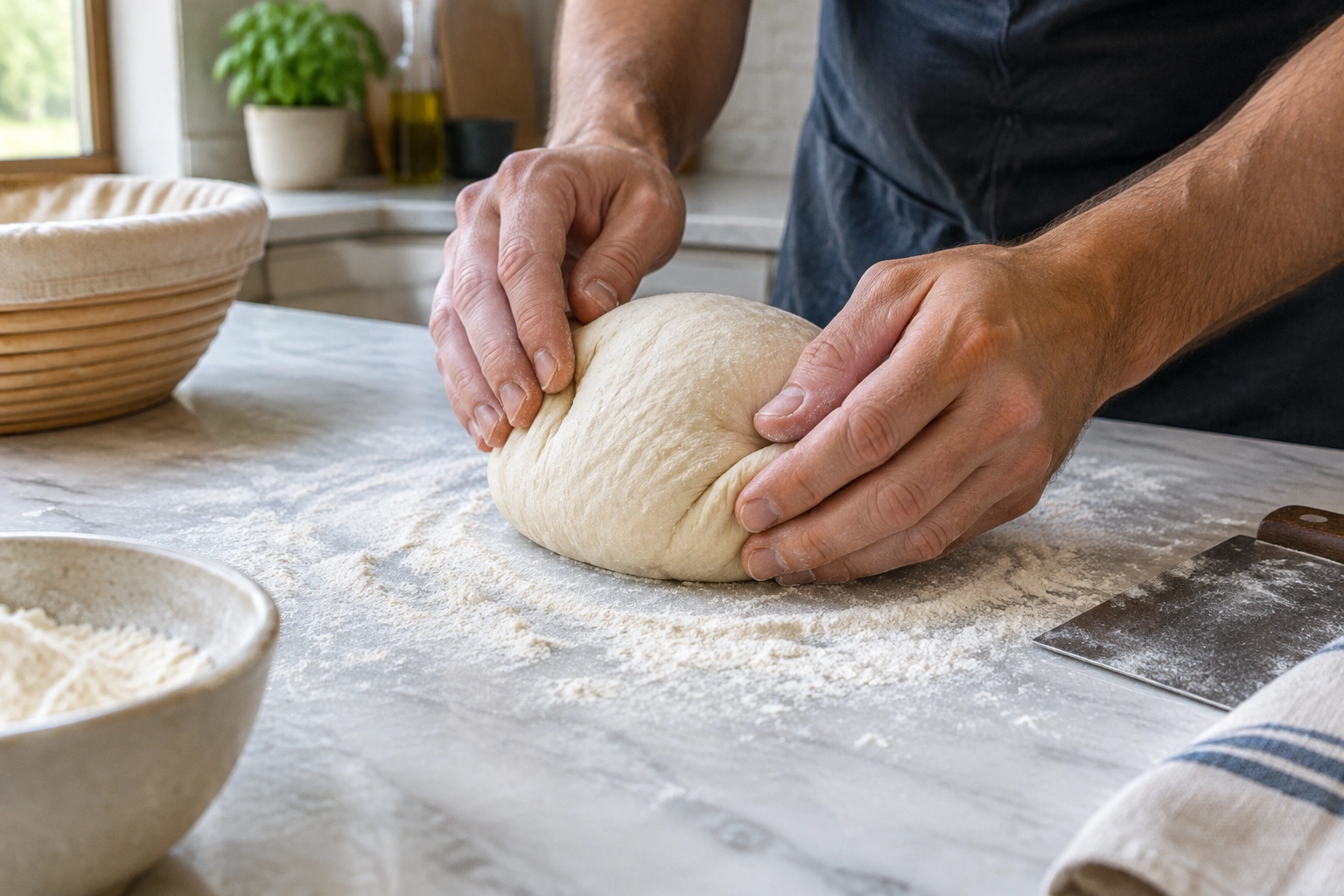
If the dough still has strength, reshape it into the form you want: loaf, boule, batard, or pizza round. The point here is to rebuild surface tension so the dough can hold its shape better in the oven.
A useful approach is to gently fold the edges into the center and shape just enough to create tension without overworking the dough. That is especially helpful when the dough has gone slack.
5. Put it into the final vessel
Place it in the pan, basket, or on the tray where it will bake. Shape matters here. If the dough is weak, a loaf pan gives it more support than a free-form bake.
6. Give it only a short second proof, if any
After a rescue reshape, the second rise should usually be brief. Watch the dough rather than the clock. If it becomes slightly puffy again but still holds structure, it may be ready.
For many pan loaves, a practical rule of thumb is to bake when the dough has risen close to the rim or only modestly above it. That is a guideline for some sandwich loaves, not a universal threshold for every dough or pan.
If the dough is already borderline weak, refrigerating it after reshaping can buy a little time. Cold will slow fermentation, but it will not rebuild a dough that has already lost most of its structure.
How the Fix Changes for Bread Dough, Pizza Dough, and Enriched Dough
Not all dough behaves the same way after overproofing.
Bread dough
Lean bread dough is usually the most forgiving. If it is overproofed but still cohesive, deflating and reshaping often gives it a second chance. The trade-off is that the finished loaf may have less oven spring and a slightly tighter crumb than planned.
Pizza dough
Pizza dough is often rescued with a knock-back approach. For pizza, the goal is usually a dough that can still stretch without tearing or turning into a puddle. If it has become too slack, a brief rest after reshaping can help it relax before stretching. If it is already collapsing, it is often better used as a flatbread-style bake than forced into a high-hydration round.
Enriched dough
Brioche, sweet rolls, and other enriched doughs can be more delicate. Fat and sugar make the dough softer and can narrow the rescue window. Handle these more gently than lean dough and expect a less dramatic recovery. If the dough is fragile and sticky, a second proof that is too long may make it collapse again.
When to Bake Immediately vs Re-Proof vs Chill
Here’s the simplest decision rule:
- Bake immediately if the dough is overproofed and fragile, but still holds its shape.
- Re-proof after reshaping if the dough has been deflated and still feels elastic enough to recover.
- Chill it if it is only slightly overproofed and you need to delay baking.
A good way to think about it is this: the more structure the dough still has, the more options you have. The less structure it has, the more you should lean toward baking soon or repurposing it.
Refrigeration is most useful when you need to slow a dough that is running ahead of schedule, such as a loaf that is nearly ready but you need 20 to 40 more minutes before baking. It is much less useful when the dough has already collapsed, because cold can slow fermentation but cannot restore lost strength.
Common Mistakes That Make Rescued Dough Fail Again
A rescue can still fail if you overcorrect.
Handling it too aggressively
Pressing too hard or tearing the dough can damage the gluten network further. Firm is fine; rough is not.
Adding too much flour
It’s tempting to dust heavily when the dough feels sticky, but too much flour can make the dough dry and dense. Use only enough to keep it manageable.
Proofing too long a second time
This is one of the most common mistakes. After rescue, the dough usually needs less time than before. If you treat the second proof like the first, you may overdo it again.
Expecting the original result
A rescued dough is not the same as a perfectly timed one. It may bake flatter or with a different crumb. That is normal and worth accepting if the alternative is throwing the batch away.
Troubleshooting: If the Dough Still Spreads, Collapses, or Bakes Dense
Sometimes the dough is salvageable, but not for the exact loaf you had in mind.
If it spreads after reshaping
The dough may not have enough strength for a tall free-form loaf. Move it to a pan, bake it as focaccia, or choose a flatter format that supports weaker structure.
If it collapses during the second proof
That usually means the dough was already too far gone or proofed too long after rescue. At that point, baking it as soon as possible may be the only way to get a usable result.
If the crumb bakes dense
Dense crumb is common in rescued dough. Overproofed dough often loses gas retention, so the final texture may be tighter than usual. That does not automatically mean failure; it may still be a good sandwich loaf or pizza base.
If the loaf has strange holes and weak spots
That can happen when the dough has over-fermented and the structure has broken down unevenly. It’s another sign that the dough was rescued late rather than early.
When Overproofed Dough Is Beyond Saving
There is a point where rescue stops being practical.
Repurpose the dough instead of trying to save it as a loaf if:
- It has completely collapsed and will not hold tension at all
- It tears easily when you try to shape it
- It spreads immediately into a puddle
- It smells spoiled rather than pleasantly fermented
- You suspect contamination or unsafe storage conditions
For safety, discard dough if it shows signs of spoilage such as mold or off odors that do not fit normal fermentation. And if the dough contains perishable ingredients and has been left out far beyond a reasonable window, be conservative.
When the dough is beyond saving as a shaped loaf, repurposing can be the smartest move. Flatbread, focaccia, or a rustic tray bake may still turn out well because those formats ask less of the dough’s structure.
How to Prevent Overproofing Next Time
The best prevention is to watch the dough, not the clock alone.
Use the environment to your advantage
Warm rooms speed fermentation. If your kitchen runs hot, shorten your proofing estimates or use the refrigerator more often.
Track dough, not just time
The same recipe can ferment at very different speeds depending on flour, yeast, dough temperature, and room conditions. Volume, feel, and the poke test are more useful than a rigid timer.
Build in a buffer
If you know you may be delayed, slow the dough down earlier rather than trying to rescue it later. Refrigeration is often the easiest way to protect a batch from running away from you.
Match the format to the dough
A dough that is borderline overproofed may still work beautifully in a pan loaf or focaccia, even if it would struggle as a tall artisan boule.
Practical Examples of Common Overproofing Scenarios
Overnight sandwich bread
A sandwich loaf left out too long at room temperature may rise beautifully and then start to weaken. In that case, deflating, reshaping, and giving it a shorter second proof can still produce a decent loaf, especially in a pan.
Slack pizza dough in the fridge
If pizza dough becomes overly soft and bubbly after cold fermentation, a gentle knock-back and brief rest can restore enough balance to stretch and bake. The main goal is to get it back to a workable state, not to make it perfect again.
Fragile enriched dough
Brioche or sweet roll dough that feels overly soft after proofing needs a lighter hand. If it is only slightly overproofed, a careful reshape may work. If it is collapsing, baking in a pan or repurposing it is often wiser than forcing a shaped loaf.
When to Consult a Master Baker
If the dough is valuable, highly enriched, or part of a professional assignment, consult a more experienced baker when you are unsure whether to save it. That is especially sensible when you are balancing food safety concerns, schedule pressure, and a dough that is already borderline.
Final Takeaway
To fix over proofed dough, think in terms of triage, not perfection. First decide whether the dough still has enough structure to rescue. Then choose the least disruptive option: bake now, deflate and reshape, or chill to slow fermentation. The earlier you catch the problem, the more likely you are to save the batch with decent texture and shape.