
How to Rotate Baking Sheets in the Oven for More Even Results
If your cookies brown faster on one side, your sheet cakes rise unevenly, or the back of the tray finishes before the front, rotating the pan can help. The simplest rule is this: rotate baking sheets when browning looks uneven, or at the recipe’s suggested halfway point if the recipe calls for it. In a standard home oven, that usually means turning the pan once during baking rather than repeatedly opening the door.
Rotation is not a cure-all. Some ovens have stronger hot spots than others, and some recipes are written to account for that. But when used at the right time, it is one of the easiest ways to improve consistency on cookies, sheet cakes, pastries, and other tray-baked items.
Why ovens bake unevenly
Home ovens rarely heat every inch of the cavity the same way. Even when the set temperature is correct, the heat inside can behave differently from front to back, left to right, and top to bottom.
A few common reasons:
- Hot spots: One area of the oven may run hotter than another, so one side of a tray browns faster.
- Rack differences: A pan on an upper rack may brown more quickly on top, while a lower rack may set and color differently.
- Airflow limits: A baking sheet blocks some circulation, especially when several trays are in the oven at once.
- Door openings: Every time the oven door opens, heat escapes and the temperature shifts briefly.
That is why rotation helps. It gives the food a chance to spend time in different parts of the oven, which can even out browning and improve consistency. If your oven seems to behave unpredictably, it may also help to read how to calibrate a home oven for baking so you know whether the issue is rotation, temperature, or both.
How to tell if your baking sheet needs rotation
You do not have to guess. The clearest clue is visual.
Look for these signs:
- The front of the tray is paler while the back is already golden.
- One side of the pan is browning faster than the other.
- Cookies on the edge are setting much sooner than the ones in the center.
- A sheet cake is rising or coloring more on one side.
- Pastry edges are done while the middle still looks underbaked.
Recipe language can also tell you something. If the instructions mention rotating the pan, the recipe writer likely knows the bake benefits from it. If the recipe says nothing, that does not mean rotation is wrong; it just means you should use your eyes and the behavior of your oven.
A useful rule: if the bake is visibly uneven and the food is still in the stage where it can be moved safely, rotate once. If everything already looks even, leave it alone.
How to rotate a single baking sheet correctly
For one tray, the most common method is a front-to-back turn. That means you leave the pan on the same rack and turn it 180 degrees so the side that faced the back of the oven now faces the door.
A simple step-by-step method
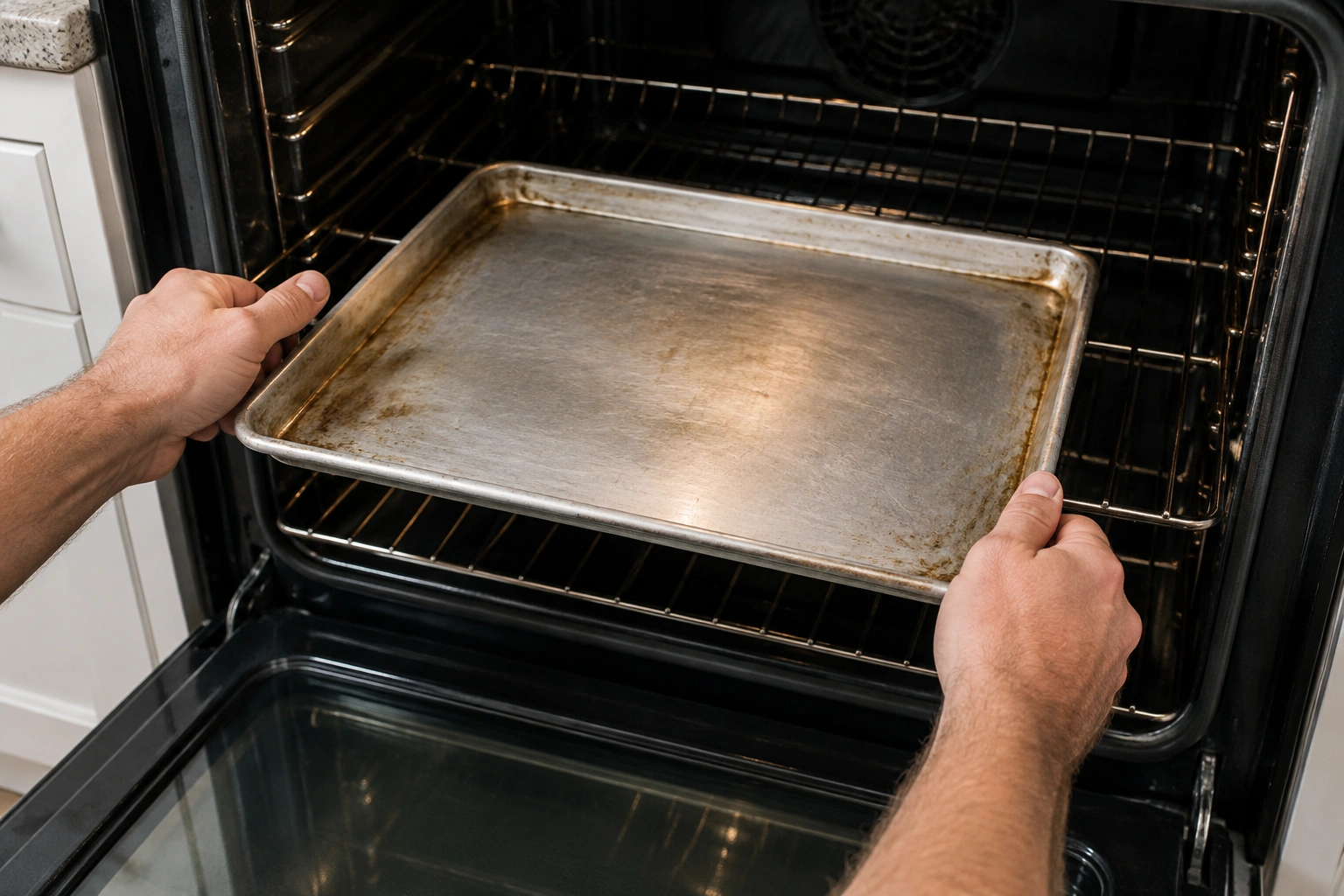
- Pull the oven rack out just enough to reach the pan comfortably.
- Lift or slide the baking sheet out slightly if needed.
- Turn the sheet pan 180 degrees.
- Push the rack back in smoothly and close the door.
This is the easiest rotation method because it changes how the tray sits in the oven without changing its height. If your oven has a hot spot toward the back, this can make a noticeable difference.
A few practical points help here:
- Use dry oven mitts or heat-resistant gloves.
- Keep the door open only as long as needed.
- Avoid jostling delicate items that are still soft, such as some pastries or just-set cookies.
If you are baking something fragile, wait until it has enough structure to handle being moved. Rotating too early can cause spreading, tearing, or uneven rise.
When to turn the pan vs. switch rack positions
People often use “rotate” to mean two different things, but they solve different problems.
Turning the pan in place
This is the 180-degree front-to-back turn described above. It helps when:
- one side of the tray browns faster than the other
- the back of the oven runs hotter than the front
- a single rack is otherwise giving you good results
Switching rack positions
This means moving the tray from one rack to another, such as from upper to lower. It helps when:
- the top of the oven browns faster than the bottom
- you are baking two trays and one rack is clearly hotter
- the oven’s heat is uneven between rack levels
If a recipe is baking unevenly because the top rack is hotter than the lower rack, a simple turn will not solve the problem. You need to change height, not just direction.
That is the key distinction: turning the pan changes front-to-back exposure; switching racks changes top-to-bottom exposure.
How to rotate two or more baking sheets at once
Multi-tray baking is where rotation matters most. With two trays, the oven often creates a stronger difference between the upper and lower rack, and airflow between pans becomes more limited.
A practical approach is to combine two actions:
- swap the trays between racks
- turn each tray 180 degrees at the same time
That gives each tray a chance to experience both rack positions and both directions in the oven. If you are baking cookies on two sheets, for example, the tray on the top rack might move to the lower rack while also being turned front-to-back.
Direct rule: if the oven is crowded, swap racks and turn trays only if there is enough space to do it cleanly; otherwise bake in batches for more even results. Crowding baking sheets can slow down browning on one tray while overexposing another. If your oven feels cramped, it is often better to bake in batches than to force too many pans in at once.
A quick comparison
| Situation | Best rotation move | Why it helps |
|---|---|---|
| One tray on one rack | Turn the pan 180 degrees | Balances front-to-back browning |
| Two trays on two racks | Swap racks and turn both pans | Addresses both rack and direction differences |
| One tray browning unevenly on one side | Turn the pan only | Keeps the bake on the same rack height |
| Top rack browns much faster than lower rack | Switch rack positions | Fixes vertical heat differences |
Best timing for rotation during baking
The most common timing is around the middle of the bake, because that is often late enough for the food to begin setting and early enough to correct uneven browning before it becomes obvious.
That said, “halfway” is a guideline, not a law. A better rule is to rotate when the food has started to set but before one side gets far ahead.
Use these timing cues:
- Cookies: often rotate at the halfway point, or a little earlier if the back row is browning faster.
- Sheet cakes: usually rotate once the surface has begun to set and the batter is no longer very fragile.
- Pastries: rotate only after the layers have enough structure to move cleanly, since delicate doughs can deform if moved too soon.
For many tray-baked items, especially cookies and sheet cakes, a single rotation is enough. Repeated opening and moving can interrupt the bake and make results less predictable.
If a recipe gives a specific rotation instruction, follow that first. Recipe developers may have already accounted for the oven behavior they expect.
Conventional oven vs. convection oven: do you still need to rotate?
A conventional oven relies on radiant heat and natural air movement. That can create more noticeable hot spots, so rotation is often more useful.
A convection oven uses a fan to move air, which usually improves circulation and can reduce the need for rotation. Even so, it does not guarantee perfect evenness. The pan may still brown more on one side, especially if the oven is crowded or the tray is large.
A practical rule of thumb:
- Conventional oven: rotation is often helpful, especially for trays on one rack or multiple trays.
- Convection oven: rotation is often less necessary, and sometimes not needed at all if the bake is already even.
- Either oven: rotate only if you see uneven browning or the recipe calls for it.
If you regularly bake with a fan-assisted oven, it can help to understand how fan settings affect temperature and timing, but that is usually only useful if you are adapting recipes or troubleshooting uneven results. This related guide on how to convert fan oven temperatures for baking without guesswork is useful if your recipes were written for a conventional oven.
How to minimize heat loss and avoid common mistakes
Rotation is useful, but it is easy to overdo it or do it in a way that creates new problems.
Common mistakes to avoid
- Opening the door too long: Heat loss can slow the bake and affect rise.
- Rotating too early: Soft batters and delicate doughs may still be setting.
- Only turning when rack position is the real issue: If top and bottom heat differ, a turn alone will not fix it.
- Crowding the oven: Too many sheets at once can block airflow.
- Changing position repeatedly: One well-timed adjustment is usually better than several small ones.
Safer, more consistent habits
- Have oven mitts ready before opening the door.
- Pull the rack out only as far as needed.
- Rotate quickly and close the door promptly.
- Use the same rotation pattern each time when testing a recipe, so you can judge results more clearly.
If you are working with darker pans, be aware that they can encourage faster browning. In that case, rotation may help with evenness, but it will not replace good pan choice and timing. For more on that, see how to adjust baking time for a dark metal pan.
Practical rotation examples for common tray-baked items
Cookies
Cookies often show hot spots clearly. If the back row browns before the front row, turn the tray front-to-back once during baking. If you are baking two sheets, swap the racks and turn both trays at the same time.
A useful sign to watch for: the edges should often be setting at a similar pace across the pan. If one side spreads more or colors faster, rotation can help even things out.
Sheet cakes
Sheet cakes usually benefit from a gentler approach. If the batter is still fluid, avoid moving the pan too early. Once the cake has begun to set and the surface is no longer very fragile, a single rotation can help one side from doming or browning more quickly than the other.
If your cake consistently bakes unevenly, rack placement may matter more than rotation alone. A middle rack is often the most stable place to start.
Pastries
Pastries are more sensitive to door openings and rough handling. For items like turnovers, hand pies, or puff pastry on a sheet pan, rotate only when the pastry has enough structure to move cleanly. If the layers are still very soft, wait a little longer.
With pastries, the goal is often to encourage even browning without disturbing the layers. A quick, careful turn is usually better than repeated adjustments.
Do you always need to rotate baking sheets?
No. If your oven bakes evenly enough, or the recipe already bakes consistently without adjustment, rotation may not be necessary at all. Some bakes are best left alone once they are in the oven.
A good default is simple: rotate only when you see unevenness, when the recipe tells you to, or when your oven’s behavior makes it worthwhile. If the tray looks even from front to back and rack to rack, there is usually no need to intervene.
Does rotating baking sheets change baking time?
Usually only a little. Rotating can slightly extend baking time because opening the door lets heat out, but the difference is often small and usually does not require a major timing change.
If you rotate quickly and the oven recovers well, you may not need to adjust the recipe timing at all. If the bake seems to be running a little long after rotation, just keep an eye on doneness and add a minute or two only if needed.
A simple decision rule you can use every time
When you are deciding whether to rotate baking sheets in the oven, use this order:
- Check the recipe first.
- Look for uneven browning or uneven setting.
- Decide whether the issue is front-to-back or top-to-bottom.
- Turn the pan, swap racks, or do both based on what you see.
- If the oven is crowded, bake in batches instead of forcing extra trays in.
- Make one quick move, then let the bake finish.
That approach keeps rotation practical instead of random. Over time, you will also learn how your own oven behaves, which is often the biggest factor in getting consistent results.
When to consult a pastry chef
If you are developing recipes, baking large sheet quantities, or repeatedly seeing uneven results even after rotating and adjusting rack position, a pastry chef can help you troubleshoot the full setup: pan type, rack placement, oven behavior, and recipe structure. That kind of feedback is especially useful when you need repeatable results for cookies, sheet cakes, or pastry production.
For most home bakers, though, the fix is usually simpler: watch the bake, rotate once when needed, and let your oven’s quirks guide your method.
FAQ
Do I need to rotate baking sheets in every oven?
Not necessarily. Some ovens bake evenly enough that rotation is not needed for every batch. If the recipe bakes evenly and you do not see hot spots, you can often leave the tray alone.
Should I rotate multiple trays at the same time?
Usually yes, if there is enough room to do it safely. On a standard home oven with two trays, swapping racks and turning both pans can improve evenness. If the oven is crowded, bake in batches for better results.
Does convection mean I can skip rotation?
Often, yes, but not always. Convection usually reduces the need for rotation because airflow is better, yet crowded ovens, large trays, or uneven recipes can still benefit from a quick turn or rack swap.
Will rotating the pan change my baking time?
Usually only slightly. Opening the oven door can add a small delay because of heat loss, but it is often not enough to require a major timing change.
What if my recipe does not mention rotation?
Use your eyes. If the bake looks even, skip it. If one side is browning faster or one rack is clearly hotter, rotate once or swap racks as needed.

