
Under-Kneaded Dough: How to Spot It, Fix It, and Prevent It Next Time

If bread dough feels frustratingly sticky, tears when you stretch it, or refuses to hold a shape, you may be dealing with under kneaded dough. That usually means the gluten network has not developed enough to trap gas well, which affects rise, oven spring, and the final crumb.
The good news: in many cases, underdeveloped dough can still be corrected before it goes too far. The trick is knowing whether the problem is truly kneading, or whether you’re actually looking at hydration, flour choice, or proofing.
What Under-Kneaded Dough Is and Why It Matters
Kneading does more than just “mix” ingredients. It organizes the proteins in flour into a gluten network that gives dough strength and stretch. When dough is under-kneaded, that network is too weak to support the loaf.
In practical terms, that means the dough may:
- spread instead of hold shape
- tear before it stretches much
- feel loose or floppy
- rise unevenly
- bake into a denser loaf than expected
That doesn’t mean the bread will be inedible. But it often means the loaf won’t have the structure you were aiming for. A sandwich loaf may slump in the pan. A boule may flatten instead of spring upward. An enriched dough may feel greasy or slack longer than expected because fat and sugar slow gluten development.
If you want a deeper look at how water levels affect dough handling, our guide to bread dough hydration will help you separate “sticky” from “underdeveloped.”
Tools and Prerequisites for Testing Dough Development
Before judging dough by feel, make sure the setup is fair.
What helps most
- Clean hands for feel-based checks
- A bench scraper for handling sticky dough
- A timer so you know how long you’ve actually kneaded
- A light dusting of flour only if needed on the work surface
- A stand mixer if you want to compare hand kneading with machine kneading
- A small piece of dough for the windowpane test
What to keep in mind first
Different doughs behave differently. A lean white sandwich dough, a whole wheat dough, and a brioche are not supposed to feel identical at the same moment in mixing. Hydration matters too: a wetter dough may still feel tacky even when it is developed enough.
That’s why time alone is a weak judge. General kneading times can be helpful as a starting reference, but they are not guarantees. The dough itself should still make the final call.
How to Recognize Under-Kneaded Dough by Look and Feel
The clearest signs are usually tactile, not visual alone.
Common signs
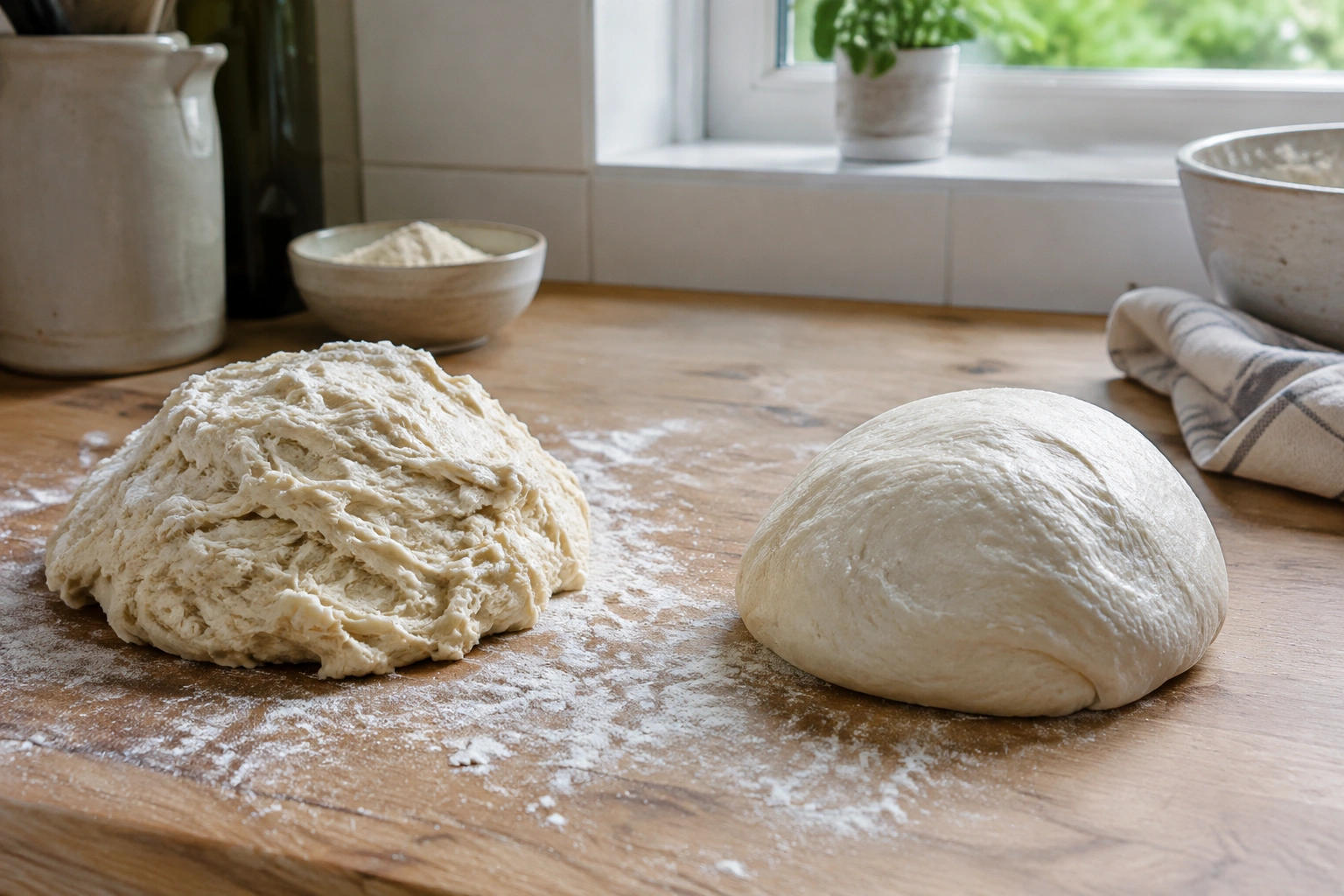
- It tears easily when you stretch it
- It feels loose or floppy instead of cohesive
- It still looks shaggy rather than smoother and more unified
- It struggles to hold shape when you try to round it
- It lacks elasticity, so it doesn’t spring back in a controlled way
The Kitchn similarly describes under-kneaded dough as loose and easy to tear.
What it feels like in your hands
A properly developed dough usually feels more alive under your palms: smoother, a little bouncy, and less ragged. Under-kneaded dough often feels as if it resists organization. You fold it, and it slumps. You stretch it, and it breaks before it glides.
One useful distinction: sticky does not automatically mean under-kneaded. A high-hydration dough can be sticky and still be well developed. If it stretches well and begins to hold shape, the issue may be hydration, not kneading.
How to Use the Windowpane Test and Other Doneness Checks
The windowpane test is one of the most useful checks for gluten development.

How to do it
- Pinch off a small piece of dough.
- Gently flatten it with your fingers.
- Stretch it slowly between your hands.
- Watch what happens as it thins.
How to interpret the result
- If it stretches thin enough to let light through before tearing, gluten is usually well developed.
- If it breaks quickly, the dough likely needs more kneading.
- If it stretches a little but tears early, it may be partially developed.
A failed or partial windowpane test is a strong clue, but not a perfect verdict. In enriched doughs, whole wheat doughs, and very high-hydration doughs, a less-than-perfect windowpane does not always mean the dough is simply under-kneaded. Texture, flour type, and formula can all affect how the dough stretches and tears.
Two other useful checks
- Finger press test: If the dough springs back immediately when lightly pressed, it may be sufficiently developed. If it doesn’t spring back at all, it likely needs more kneading.
- Stretch test: If the dough tears when you pull it gently, it is still underdeveloped.
These tests work best together. A dough that passes one but not another needs a closer look, not a rushed decision.
Under-Kneaded vs Properly Kneaded vs Over-Kneaded Dough
Here’s a quick comparison to help you decide what you’re seeing.
| Dough state | Look | Feel | Stretch behavior | Shape-holding | What to do |
|---|---|---|---|---|---|
| Under-kneaded | Shaggy, loose, rough | Slack, weak, sticky or tacky | Tears easily, poor elasticity | Poor | Knead more in short bursts |
| Properly kneaded | Smoother, more cohesive | Elastic, supple, responsive | Stretches without tearing too soon | Good | Move on to proofing |
| Over-kneaded | Very tight or overly warm; may look smooth but feel resistant | Tough, tight, sometimes warm | Resists stretch, may feel rubbery | Can be unstable | Rest dough and reassess; avoid more mixing |
| Under-proofed | May look okay before proofing, but dense after | Firm, underexpanded | Not the main issue | Can seem tight because fermentation is incomplete | Give it more time, not more kneading |
This table matters because bakers often blame the wrong stage. A dough that is dense after proofing may not be under-kneaded at all; it may simply be under-proofed.
What Causes Dough to Be Under-Kneaded
Under-kneading usually comes from one of a few practical mistakes.
1. Stopping by the clock instead of by feel
A recipe may say “knead 8 minutes,” but flour, humidity, mixer speed, and dough size all change the outcome. Time is a guide, not a verdict.
2. Using too gentle a mixer setting
A stand mixer can knead efficiently, but if the speed is too low or the dough hook is not doing enough work, gluten development may lag. On the other hand, cranking the speed too high can warm the dough too much. The sweet spot is usually moderate, not aggressive.
3. Confusing sticky dough with under-kneaded dough
This is one of the most common traps. Sticky dough may simply be high hydration. If it stretches well and begins to hold shape, more flour is not always the answer.
4. Enriched dough developing more slowly
Butter, eggs, sugar, and milk can slow gluten development. That’s why brioche or similar doughs often need more patience than a lean dough.
If you want to compare dough styles, our guide to enriched dough vs lean dough is a useful companion.
5. Whole grain flour changing the texture
Whole wheat flour can make dough feel less extensible because bran interferes with the gluten network. That means the dough may need a different handling rhythm than white flour dough.
How to Fix Under-Kneaded Dough Before Proofing
If the dough is clearly underdeveloped and you have not moved into proofing yet, the fix is usually straightforward.
A practical recovery method
-
Let the dough rest for a few minutes.
This short rest helps the flour hydrate and can make the next kneading round more effective. -
Knead again in a short burst.
Don’t force one long, exhausting session. Work the dough, then reassess. -
Repeat the rest-and-knead cycle if needed.
A brief rest followed by a little more kneading can help the dough organize without overworking it. -
Test again with the windowpane and stretch checks.
You’re looking for better elasticity and less tearing, not perfection. -
Stop once the dough holds together well and stretches more cleanly.
If you keep going just because the dough still feels a bit tacky, you may overwork it or warm it too much.
When to switch from hand to mixer
If hand kneading is not building structure efficiently, a stand mixer can help. That trade-off is simple: hand kneading gives you excellent feedback, while a mixer gives speed and consistency. For sticky or enriched doughs, many bakers use both—some initial mixing by hand, then machine kneading for development.
What to Do If the Dough Seems Under-Kneaded After the First Rise
This is where judgment matters. Once dough has risen, you are no longer dealing with a clean kneading problem.
If the dough is only slightly underdeveloped
A brief re-knead can still help, especially if the dough has not become fragile or overproofed. After that, reshape it and continue proofing. Keep the kneading short so you do not knock out all the gas.
If the dough has risen but still feels weak
It is usually better to stop trying to “fix” it with more kneading. At this stage, reshape gently, continue proofing if needed, and bake with the structure you have. The dough may still make acceptable bread even if it is not ideal.
If the loaf has clearly gone too far
If the dough has become very slack, collapsed, or overproofed, it is no longer realistically salvageable as the original loaf you intended. More kneading will not restore the fermentation balance, and the result is likely to be disappointing no matter what. At that point, it is better to accept the limitation and move on than to keep working it.
If the bread bakes dense anyway
Do not assume the kneading was the only issue. Dense bread after proofing can come from under-proofing, weak shaping, or formula issues as well. That’s why it helps to diagnose the whole process, not just one stage.
How Kneading Time Changes by Hand, Stand Mixer, and Dough Type
There is no single kneading time that works for every dough.
By hand
Hand kneading often takes longer because your mixing force is gentler and less consistent. The upside is control: you can feel the dough changing and stop before it becomes too tight.
In a stand mixer
A mixer usually develops dough faster, but speed matters. Too slow and the dough may not develop efficiently; too fast and it can heat up. General mixer times can be helpful as a reference, but the dough itself should still make the final call.
By dough type
- Lean doughs: usually develop more predictably
- Enriched doughs: often need more kneading because fat and sugar slow gluten formation
- Whole wheat doughs: may need extra attention because bran affects structure
- High-hydration doughs: may feel softer and stickier even when sufficiently developed
That’s why a baker’s eye should always weigh formula, not just the clock.
Common Mistakes That Make Dough Seem Under-Kneaded
Sometimes the dough is not truly under-kneaded—it just looks that way.
Mistake 1: Adding flour too early
A sticky dough is not always a flour problem. Adding too much flour can make a dough stiff before gluten has a chance to organize properly.
Mistake 2: Stopping when the dough “looks mixed”
A dough can look combined long before it is developed. Smoothness and strength are what matter.
Mistake 3: Confusing lack of rise with weak kneading
If the dough has not proofed enough, it may still feel dense and underpowered even if the gluten is adequate.
Mistake 4: Expecting every dough to pass the same test the same way
A high-hydration dough may never feel exactly like a firm sandwich dough. That does not automatically mean it is wrong.
How to Prevent Under-Kneading in Future Batches
The best prevention is a repeatable decision process.
Use this simple routine
- Mix until the dough comes together.
- Knead until it begins to feel smoother and more elastic.
- Pause and test, rather than guessing.
- Use the windowpane test as one check, not the only check.
- Adjust for flour type and enrichment.
- Trust feel more than the timer.
A useful mental shift is this: you are not trying to hit a magic number of minutes. You are trying to build enough structure for the dough you actually made.
If you want a broader formula-level view, our guide on how much salt to use in bread dough can also help, since salt affects dough strength and fermentation behavior.
Troubleshooting Guide for Sticky, Tearing, or Dense Dough
Here is the quickest way to separate the most common problems.
If the dough is sticky but stretchy
It may be high hydration, not under-kneaded. Check whether it holds some shape and passes a modified stretch test before adding more flour.
If the dough tears easily and feels loose
That is a stronger sign of under-kneading. Give it more kneading in short rounds with rests.
If the dough is dense after proofing
Look at proofing time, room temperature, shaping, and yeast activity. Kneading may not be the main issue anymore.
If the dough feels tight and fights back
It may be sufficiently kneaded or even overworked. Rest it before doing anything else.
If you are unsure
Ask two questions:
1. Does it stretch without tearing too soon?
2. Does it hold shape better than it did earlier?
If both answers are no, more kneading is likely needed. If the answers are yes, move on.
When to Consult a Master Baker
If you are working on a formula that keeps failing despite careful kneading, or if a dough behaves oddly across multiple batches, it may be time to get an experienced second opinion. A master baker can help you evaluate flour strength, hydration, mixing intensity, and proofing together instead of treating each step in isolation.
That kind of feedback is especially useful with enriched doughs, whole grain formulas, or high-hydration breads where feel can be harder to interpret at first.
FAQs
Can under-kneaded dough still bake into edible bread?
Yes. It may still bake, but the loaf often has weaker structure, less oven spring, and a denser crumb than intended.
Is a failed windowpane test always a sign of under-kneading?
Not always. Hydration, flour type, and enrichment can affect how the dough stretches and tears.
Should I add flour if the dough is sticky?
Only if the dough is truly too wet for the formula. Sticky alone is not proof that it needs more flour.
How do I know if I should keep kneading or let it proof?
If the dough tears easily, lacks elasticity, and won’t hold shape, it likely needs more kneading. If it stretches well and holds together, it may be ready to proof.
Can I fix under-kneaded dough after the first rise?
Sometimes, but only in a limited way. If the dough is just slightly underdeveloped, a brief re-knead followed by reshaping and more proofing may help. If it is already well proofed, slack, or collapsing, it is usually better to stop trying to knead it and bake with what you have.
Is hand kneading better than a mixer?
Neither is universally better. Hand kneading gives more tactile control; a mixer is faster and more consistent. The best choice depends on the dough and your workflow.
Why does my dough still feel dense after kneading?
It may be under-kneaded, but it could also be under-proofed or made with a flour that behaves differently. Check the full process before changing one variable.
Do whole wheat and enriched doughs need different kneading?
Yes, usually. Whole wheat can behave less elastically, and enriched doughs often take longer to develop because fat and sugar slow gluten formation.
Final thought
Under-kneaded dough is less a single mistake than a signal: the gluten network is not ready yet. Once you learn to read the dough by feel, stretch, and shape-holding, you stop guessing and start making better bread decisions. That’s when kneading becomes less of a chore and more of a craft.