Vinegar is acetic acid in water, and baking soda is sodium bicarbonate. When they mix, they make carbon dioxide, water, and sodium acetate, which is why the reaction fizzes.
Vinegar and baking soda create one of the most familiar fizzing reactions in the kitchen, but the chemistry is often oversimplified. This guide explains the chemical formula for vinegar and baking soda, what really happens when they mix, and when the reaction is useful in baking, cleaning, and classroom science.
- Formula: Vinegar’s active acid is acetic acid, CH3COOH, and baking soda is NaHCO3.
- Reaction: The mix produces carbon dioxide gas, water, and sodium acetate.
- Use: The fizz is helpful for demos and some baking, but it is not a.
- Safety: Never seal the mixture in a closed container because gas pressure can build quickly.
- Best practice: Measure carefully, match the recipe or task, and rinse food-contact surfaces well.
Chemical Formula for Vinegar and Baking Soda: What Each Ingredient Actually Is
To understand the reaction, it helps to start with the ingredients themselves. Vinegar is not a single pure compound, and baking soda is a specific chemical with a straightforward formula.
Acetic acid in vinegar: formula, concentration, and why it matters
Vinegar is mostly water with acetic acid dissolved in it. The chemical formula for acetic acid is CH3COOH, and that is the ingredient responsible for vinegar’s sour taste and acid behavior.
Most household vinegar is sold at a concentration around 5% acetic acid, though the exact amount can vary by brand and type. That concentration matters because the strength of the acid affects how vigorously it reacts with baking soda and how useful it is in recipes or cleaning tasks.
In baking, vinegar is usually used in small amounts, so its flavor impact can be mild when balanced by other ingredients. In cleaning or science demos, the concentration still matters, but more vinegar does not automatically mean better results.
Sodium bicarbonate in baking soda: formula, purity, and common label terms
Baking soda is sodium bicarbonate, with the chemical formula NaHCO3. It is an alkaline powder, and it reacts with acids to release carbon dioxide gas.
On labels, you may see “baking soda,” “sodium bicarbonate,” or “bicarbonate of soda,” depending on the country or brand. These terms usually refer to the same ingredient, but purity and particle size can vary slightly between products.
For baking, you want fresh baking soda that is dry, free-flowing, and stored away from moisture. If it has absorbed humidity, it may still work, but it can clump and measure less accurately.
If you are comparing brands, read the ingredient list first. For true baking soda, the label should list sodium bicarbonate as the only ingredient.
What Happens When Vinegar and Baking Soda Mix at the Molecular Level
The visible fizz is the result of an acid-base reaction. In simple terms, the acid in vinegar gives up a hydrogen ion, and the bicarbonate in baking soda helps form carbon dioxide, water, and sodium acetate.
The acid-base reaction that produces carbon dioxide, water, and sodium acetate
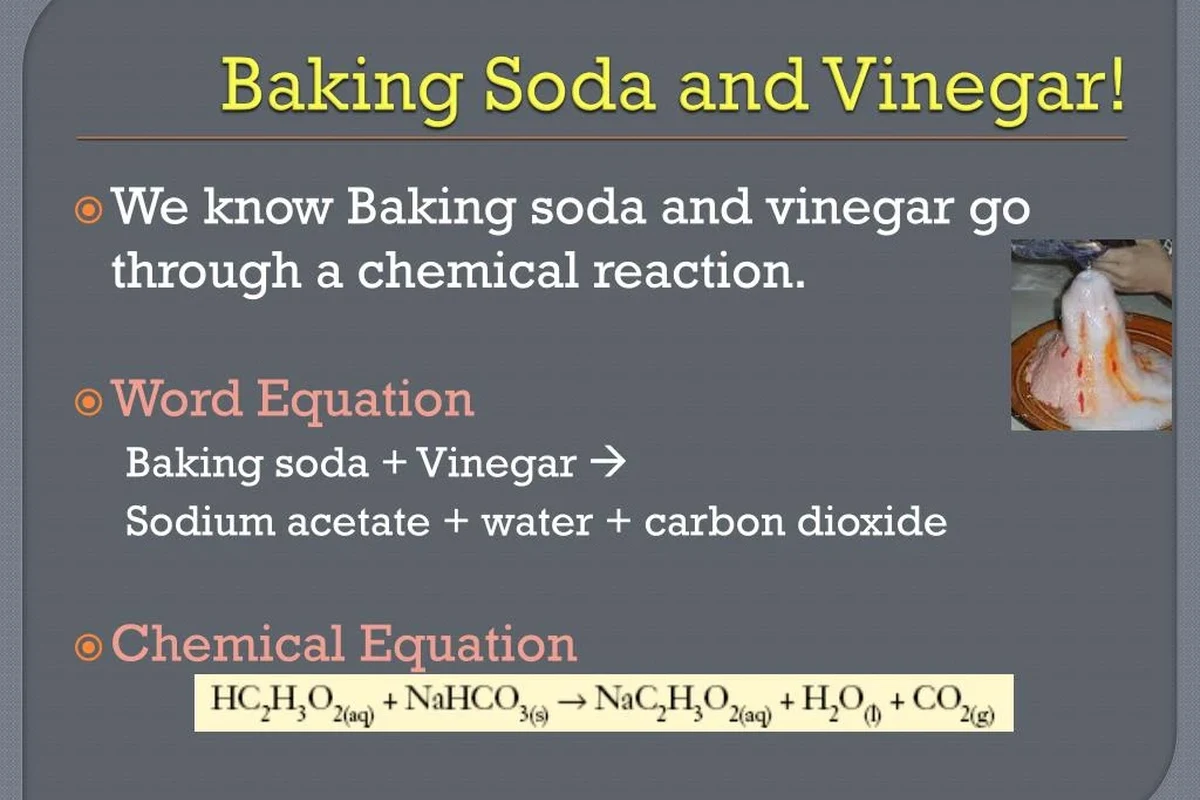
The basic reaction is often written as: acetic acid + sodium bicarbonate → sodium acetate + water + carbon dioxide. In chemical form, that can be shown as CH3COOH + NaHCO3 → CH3COONa + H2O + CO2.
The carbon dioxide is the gas that creates bubbles and foam. The sodium acetate stays dissolved in the liquid unless the mixture dries out or becomes concentrated enough to leave residue.
This is why the reaction is easy to see but not always useful for deep cleaning. The gas is dramatic, but the leftover liquid is mostly a mild salt solution with water.
Why the reaction foams so quickly and why the fizz is not “proof” of cleaning power
The reaction foams quickly because gas forms faster than it can escape from the liquid. If the mixture is in a narrow cup, bottle, or drain opening, the bubbles pile up and look especially active.
That visual effect can be misleading. Fizzing shows that a reaction happened, but it does not prove that grease, baked-on residue, or mineral buildup has been removed.
For cleaning, contact time, surface type, and mechanical scrubbing often matter more than bubbling. If you want a broader explanation of this kitchen chemistry, see our baking soda and vinegar reaction explanation.
The fizz is caused by carbon dioxide gas, not by “boiling” or heat from the reaction. In many small mixtures, the temperature change is minor compared with the visible foam.
Why This Reaction Shows Up in Baking, Cleaning, and School Science Demos
This reaction is popular because it is safe enough for supervised demonstrations, easy to observe, and based on a real chemical process. It also connects directly to baking science, where acid and alkali reactions help create lift.
How the gas-producing reaction is used in pastry and baking classrooms
In pastry and baking classrooms, this reaction is often used to teach leavening, measurement, and ingredient balance. Students can see how gas production changes batter texture and why a recipe needs the right ratio of acid to base.
It is also a useful way to show why some batters rise immediately while others rely on trapped steam, whipped air, or yeast. The reaction is simple, but it introduces core baking ideas like timing, mixing, and structure.
In real recipes, the goal is not just gas production. The batter or dough must also hold that gas long enough to create volume and a good crumb.
Common household and educational uses in 2026 and where the reaction is misunderstood
In 2026, vinegar and baking soda are still commonly used in classroom volcanoes, quick science demos, and some household cleaning routines. They are also mentioned often in online tips for deodorizing, unclogging, and stain removal.
Where the reaction is misunderstood is in assuming that more fizz means more cleaning, more deodorizing, or a better result. In practice, the chemistry is limited by the amount of acid and base present, and many jobs need a different cleaner altogether.
If your goal is oven cleaning, the reaction alone is not the whole answer. For a more practical look at that use case, you can read about baking soda vinegar cleaning ovens.
Ingredient Ratios, Measurement, and What Changes the Reaction Strength
The strength of the reaction depends on how much acid and base are present, how concentrated the vinegar is, and whether water is diluting the mixture. The best ratio depends on your goal, not on a single universal rule.
How vinegar concentration, baking soda amount, and water content affect output
A stronger vinegar concentration generally provides more acid molecules per spoonful, which can increase reaction intensity. More baking soda can create more gas only if there is enough vinegar available to react with it.
Water slows things down by diluting the ingredients. That can be helpful for spreading the mixture over a surface, but it can also make the fizz look weaker even when the chemistry is still happening.
Practical example comparisons: small-scale test, classroom demo, and kitchen use
For a small-scale test, a teaspoon or two of each ingredient is usually enough to show the reaction clearly without making a mess. That is helpful when you want to observe the foam and avoid wasting ingredients.
For a classroom demo, larger amounts may be used, but the setup should still be controlled and open to the air. For kitchen use, especially in baking, only the amount the recipe calls for should be used because excess acid or base can affect flavor and texture.
Best for observing bubbles, measuring reaction speed, and learning the basic chemistry.
Best for recipe lift when the acid is balanced with the rest of the batter.
Common mistakes: overpouring, using too much powder, and expecting a one-to-one cleanup result
One common mistake is overpouring vinegar and expecting the extra liquid to improve the result. Once the baking soda is used up, extra vinegar just adds more liquid and acidity.
Another mistake is dumping in too much baking soda. If there is not enough acid, the powder can remain behind and leave a chalky residue or salty aftertaste in food applications.
It is also a mistake to expect a one-to-one cleanup result, as if the fizz automatically dissolves grime. Some messes need soaking, scrubbing, or a cleaner designed for that surface.
The mixture fizzes a lot but leaves white residue behind.
There was likely too much baking soda or not enough liquid to fully dissolve it. Use smaller amounts and wipe the surface well after the reaction stops.
Safety, Surface Compatibility, and When Not to Combine Them
Vinegar and baking soda are common household ingredients, but they still need sensible handling. The reaction can create pressure, splatter, and residue, especially when used in the wrong container or on the wrong surface.
Pressure buildup in closed containers and other avoidable hazards
Never combine vinegar and baking soda in a sealed bottle, jar, or other closed container. Carbon dioxide gas builds quickly and can cause pressure buildup, which may force the container to burst or spray liquid.
Use open containers and keep the setup stable on a counter or tray. If children are involved, adult supervision is important, especially for larger demos or anything near the face.
Do not cap, shake, or store an active vinegar-and-baking-soda mixture in a sealed container. Pressure can build fast and create a spill or injury risk.
Surface limitations for stone, aluminum, delicate finishes, and food-contact areas
Vinegar is acidic, so it can dull or damage some stone surfaces, especially if used repeatedly or left on too long. Aluminum can also react poorly with acidic cleaners, and delicate finishes may lose shine.
For food-contact areas, rinse thoroughly after use. If you are cleaning a prep surface, follow with clean water and dry the area so no residue is left behind.
When in doubt, check the manufacturer’s care instructions for countertops, cookware, and appliances. That is especially important for coated surfaces and specialty materials.
Ventilation, eye protection, and cleanup basics for home and school settings
Use the reaction in a well-ventilated area, especially if you are working with larger volumes. The ingredients themselves are ordinary, but splashes can still irritate eyes.
For school demos, eye protection is a smart basic precaution. Clean up the foam with water and a cloth, and dry the area so it does not become slippery.
Keep the mixture away from your face and from small children’s hands. Even a mild reaction can splash into eyes if the container tips over.
How the Reaction Connects to Baking Science and Leavening
This reaction matters in baking because gas is one of the main ways batter expands in the oven. But a successful rise depends on the whole formula, not just on adding an acid and a base.
When acid-base reactions help baked goods rise and when they do not
Acid-base reactions help when the recipe is designed to trap the gas and support the structure as it bakes. Muffins, quick breads, and some cakes often use this principle.
They do not help much if the batter is too thin, overmixed, or missing enough structure to hold the bubbles. In that case, the gas escapes before the oven can set the crumb.
Why baking soda needs an acid partner in recipes and what vinegar contributes
Baking soda needs an acid partner because it does not create enough lift on its own in most recipes. Without acid, it may leave a soapy or metallic taste and can also affect browning and color.
Vinegar contributes acidity, but it also contributes liquid, so the recipe must account for that moisture. In many formulas, other acids such as buttermilk, yogurt, lemon juice, or natural cocoa may be a better fit than vinegar.
If you are unsure whether to swap baking soda for baking powder, read our guide on using baking soda instead of baking powder safely before making changes.
Signs of overreaction, flat batter, or off-flavors in baked applications
If a batter foams too early, it may lose lift before it reaches the oven. That can happen when wet and dry ingredients are mixed too soon or when the batter sits too long after the acid and base meet.
A flat, dense result can also mean the leavening was not balanced correctly. Off-flavors may show up as bitterness, soapiness, or a sharp acidic note, depending on which ingredient was overused.
The batter rises in the bowl but bakes up dense.
The reaction likely started too early or the batter was overmixed. Combine ingredients quickly, bake promptly, and follow the recipe’s acid and soda balance.
Storage, Freshness, and Troubleshooting for Best Results
Good storage keeps both ingredients reliable. Since this reaction depends on simple chemistry, freshness and dryness matter more than many beginners expect.
How to store vinegar and baking soda so they stay effective
Store vinegar tightly closed at room temperature away from strong heat and direct sunlight. Most household vinegar is shelf-stable, but the flavor and quality are best when the bottle is kept sealed.
Store baking soda in a dry container with the lid closed. Moisture can cause clumping and may reduce its usefulness for baking or science demos.
How to test whether baking soda is still active before using it
A quick freshness check is to add a small amount of vinegar to a spoonful of baking soda. If it fizzes actively, the baking soda is still reacting as expected.
That test is useful, but it is not a perfect measure of baking performance. For recipes, the best proof is still a correctly mixed batter and a finished bake with the right rise and flavor.
If your baking soda has been open for a long time or stored in a humid kitchen, replace it if the texture seems damp, clumpy, or weak in test reactions.
What to do if the reaction is weak, messy, or leaves residue
If the reaction is weak, check whether the vinegar is diluted too much or whether the baking soda is old and clumped. Also check the ratio, because too little acid or too little powder can both reduce visible fizz.
If the reaction is messy, use a larger bowl or tray and add the ingredients more slowly. If residue remains, wipe with water and a cloth after the bubbling stops, then dry the area.
For stubborn household cleaning jobs, it may help to choose a different method instead of repeating the reaction. Our guide to cleaning drains with vinegar and baking soda explains where that use makes sense and where it does not.
Final Recap: The Correct Formula, the Real Reaction, and the Best Use Cases
The chemical formula for vinegar and baking soda is really the formula of two ingredients that react together: acetic acid in vinegar, CH3COOH, and sodium bicarbonate in baking soda, NaHCO3. When they meet, they form carbon dioxide, water, and sodium acetate.
Simple summary of the chemical formula for vinegar and baking soda
Vinegar is a dilute solution of acetic acid in water, usually around 5% for household use. Baking soda is sodium bicarbonate, a stable alkaline powder used in baking, cleaning, and science demonstrations.
When this reaction is useful, when it is mostly a classroom demonstration, and how to use it wisely
This reaction is useful when you need visible gas production, a baking rise from a balanced acid-base formula, or a simple classroom chemistry example. It is mostly a demonstration when people expect the fizz alone to deep-clean a surface or solve a tough problem.
The safest and most effective approach is to use it for the job it actually does well, measure carefully, and avoid sealed containers or sensitive surfaces. If you want more baking-soda science, start with small tests, follow the recipe or care instructions, and treat the fizz as chemistry, not magic.
Vinegar and baking soda react in a simple acid-base process that produces carbon dioxide, water, and sodium acetate. Use that reaction for controlled demos and recipe leavening, but do not expect fizz alone to replace proper cleaning or recipe balance.
Frequently Asked Questions
Vinegar is mainly acetic acid, CH3COOH, dissolved in water, and baking soda is sodium bicarbonate, NaHCO3. When they react, they form carbon dioxide, water, and sodium acetate.
Not always. Once the baking soda is used up, extra vinegar only adds more liquid and acidity, not more fizz.
Yes, but only when the recipe is designed for that acid-base reaction. The batter must also have enough structure to hold the gas until baking sets it.
No. The reaction creates carbon dioxide gas, which can build pressure in a sealed container and cause it to burst or spray.
The fizz shows that gas is being released, but it does not prove that dirt or grease has been removed. Cleaning often depends more on scrubbing, soaking, and the right product for the surface.
Add a small amount of vinegar to a spoonful of baking soda. If it fizzes actively, the baking soda is still reacting, though freshness does not guarantee perfect baking results.
