
What Exactly Does an Air Fryer Do?
Quick Answer
An air fryer is a compact convection cooker that surrounds food with rapidly moving hot air. That concentrated airflow cooks the surface quickly, encourages browning, and can make foods crisp with far less oil than deep frying. It can also roast, bake, toast, and reheat food, which is why Consumer Reports describes air frying as a form of convection cooking.
What an air fryer actually does
- Circulates hot air: A powerful fan moves heated air around the food.
- Browns the surface: Dry, concentrated heat promotes a golden exterior.
- Creates crisp texture: The perforated basket lets hot air reach more of the food’s surface.
- Cooks small batches fast: The compact chamber heats more quickly than many full-size ovens.
- Handles several methods: You can roast vegetables, bake small batches, cook proteins, and revive crispy leftovers.
The important limitation
- It does not deep-fry food because the food is not submerged in hot oil.
If you have ever looked at an air fryer and wondered what it does differently from an oven, the answer is mostly about airflow, heat concentration, and size.
I find it easier to understand an air fryer once you stop thinking of it as a fryer. Think of it as a small, powerful convection oven designed to brown food quickly.
In This Guide
How Does an Air Fryer Actually Work?
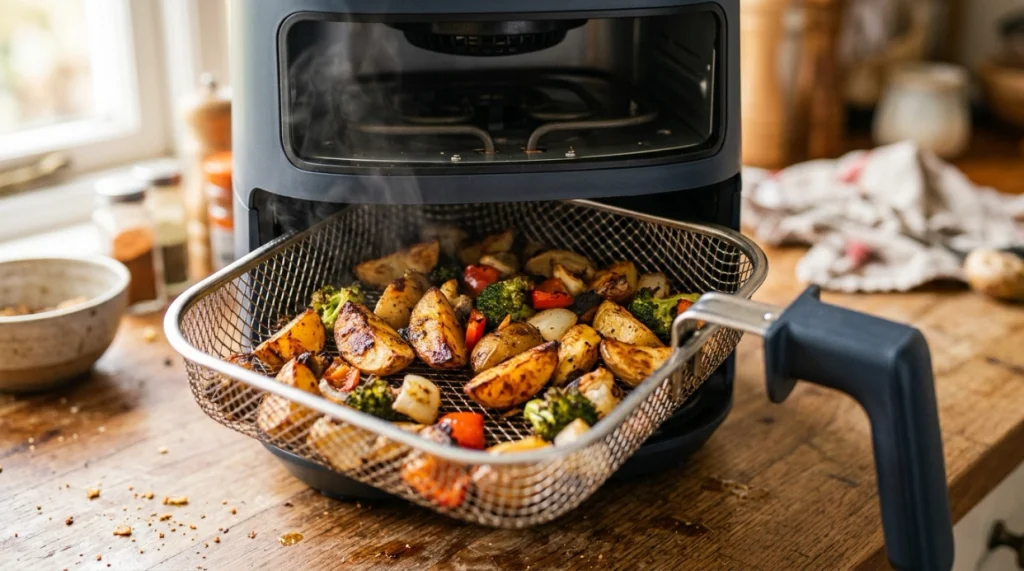
An air fryer heats air and uses a fan to move that hot air rapidly around food. The process is a form of convection cooking, meaning heat is transferred partly by moving air rather than only by still heat surrounding the food.
The compact chamber makes a major difference. Hot air remains close to the food instead of moving through the much larger space inside a conventional oven.
Definition: An air fryer is a countertop convection appliance that uses a heating element and high-speed fan to circulate hot air around food in a small cooking chamber.
What happens after you press Start?
- The heating element gets hot. Most basket-style air fryers place the main heat source above the food.
- The fan moves heated air. That air is pushed rapidly through the cooking chamber.
- Air flows around the food. A perforated basket or crisper tray exposes more surface area.
- Surface moisture evaporates. A drier exterior can brown and crisp more effectively.
- Heat continues toward the center. The inside cooks while the exterior develops color and texture.
That is why frozen fries can become crisp without floating in oil. It is also why breaded chicken, roasted vegetables, pizza, and pastries can brown so quickly.
Serious Eats’ explanation of air fryer mechanics also highlights the combination of a compact chamber, strong fan, and perforated basket.
Is “rapid air” something completely different?
Not really. Manufacturers may use names such as rapid air, air crisp, or turbo convection, but the core idea is similar: heated air moves rapidly around the food.
The exact fan speed, heating-element design, basket shape, and software vary between models. Those differences explain why two air fryers can cook the same food at slightly different speeds.
What Can You Actually Cook in an Air Fryer?
An air fryer can do much more than make fries. Its strongest jobs are usually crisping, roasting, reheating, and small-batch baking.
As of 2026, many models also include separate roast, bake, broil, dehydrate, or reheat programs. Those buttons change settings, but the appliance still relies heavily on controlled hot-air circulation.
Foods that suit air frying especially well
- Frozen foods: fries, nuggets, breaded fish, mozzarella sticks, and similar products.
- Vegetables: broccoli, Brussels sprouts, cauliflower, potatoes, carrots, and squash.
- Proteins: chicken pieces, salmon, pork chops, burgers, and meatballs.
- Leftovers: pizza, roasted potatoes, fried foods, and other foods that lose texture in a microwave.
- Small baked goods: cookies, biscuits, rolls, brownies, and some small cakes.
- Toasted ingredients: nuts, breadcrumbs, and other foods that benefit from dry heat.
Can an air fryer really bake?
Yes. Because it is a convection appliance, an air fryer can bake when the pan fits and the recipe suits strong circulating heat.
I pay the most attention to the top surface when air-frying baked goods. Browning can happen before the center has finished cooking, especially with deep cake batter.
King Arthur Baking’s air fryer baking guidance recommends starting with recipes that suit the appliance and adjusting traditional oven recipes carefully.
Cookies, biscuits, rolls, and small pastries are often easier than a deep, wet cake. Their smaller size allows the center to cook before the surface becomes too dark.
Is an Air Fryer Different From an Oven or Deep Fryer?
An air fryer is much closer to a convection oven than a deep fryer. The biggest differences are chamber size, airflow intensity, capacity, and the way food is positioned.
A deep fryer works differently because hot oil completely surrounds the food. Air cannot transfer heat in exactly the same way as liquid oil.
| Feature | Air Fryer | Conventional Oven | Deep Fryer |
|---|---|---|---|
| Main heat medium | Fast-moving hot air | Heated oven air | Hot cooking oil |
| Oil needed | Usually none to a light coating | Depends on recipe | Enough to submerge food |
| Cooking space | Small and concentrated | Large | Oil-filled pot or vat |
| Best advantage | Fast crisping and small batches | Large-capacity cooking and baking | Traditional fried crust |
| Main limitation | Limited basket capacity | More space to heat | More oil, cleanup, and handling |
How should you convert an oven recipe?
A useful starting point for many baked foods is to reduce the oven temperature by about 25°F. Then begin checking the food earlier than the original recipe suggests.
| Conventional Oven | Air Fryer Starting Point | When to Start Checking |
|---|---|---|
| 400°F / 204°C | 375°F / 191°C | About 20–25% earlier |
| 375°F / 191°C | 350°F / 177°C | About 20–25% earlier |
| 350°F / 177°C | 325°F / 163°C | About 20–25% earlier |
| 325°F / 163°C | 300°F / 149°C | About 20–25% earlier |
These numbers are starting points, not guarantees. Basket size, fan power, food thickness, and the amount of food being cooked all affect timing.
Why Does an Air Fryer Make Food Crispy?
An air fryer encourages crispness by combining dry heat with rapid airflow. The moving air helps remove moisture from the surface while heat drives browning reactions.
That dry surface matters. Food struggles to become crisp while its exterior remains covered with water or steam.
Airflow is only part of the equation
The perforated basket allows hot air to reach the sides and underside of many foods. That is one reason a basket works differently from placing food in a deep solid pan.
Spacing matters too. When pieces are packed tightly together, escaping steam can keep neighboring surfaces moist.
- Dry the surface: Pat moist ingredients dry before seasoning when appropriate.
- Leave breathing room: Avoid filling every gap in the basket.
- Use a little oil when useful: A light coating can improve browning on vegetables and some breaded foods.
- Turn or shake food: Moving pieces can expose pale areas to stronger airflow.
Does air-fried food taste exactly like deep-fried food?
No. An air fryer can produce a crunchy, browned exterior, but it does not duplicate the texture created by immersing food in hot oil.
This difference is obvious with foods such as traditional doughnuts or wet-battered fried chicken. Deep frying transfers heat through oil and creates a different crust.
For frozen fries, breaded foods, roasted vegetables, and reheated pizza, the distinction may matter less. Those foods are already well suited to dry, high-heat cooking.
What Does an Air Fryer Not Do Well?
An air fryer is versatile, but it is not the best tool for every recipe. Its strongest features can also create its biggest limitations.
Large batches can be frustrating
The basket needs open space for airflow. If you pile food too deeply, the top may brown while lower pieces remain soft.
For a large family meal, a full-size oven may be more practical. Cooking four small air-fryer batches can erase the time you saved on preheating.
Loose wet batter can be troublesome
A thin batter does not instantly set the way it does when dropped into hot oil. Moving air may blow or drip the coating before it firms.
Dry breading, crumbs, or batter designed specifically for air frying usually behaves better.
Deep cakes require careful heat control
Air fryers deliver intense heat near the top of the food. A thick cake can therefore become brown above while remaining underbaked in the middle.
Smaller pans and air-fryer-specific cake recipes reduce that problem. King Arthur Baking recommends paying close attention to pan size, temperature, and top browning when baking cakes in an air fryer.
Light items can move around
Powerful airflow can lift loose parchment, tortillas, cheese slices, herbs, or lightweight toppings. Never let empty parchment sit loose near the heating element.
The food itself should hold parchment down. Follow the manufacturer’s instructions for liners and accessories.
How Do You Get Better Results From an Air Fryer?
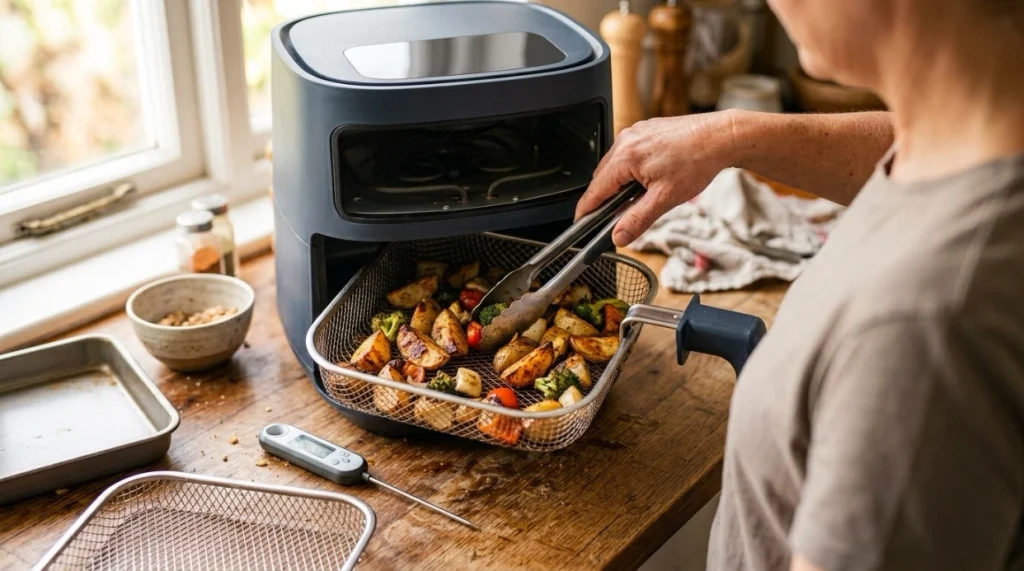
The biggest improvement usually comes from treating the air fryer as its own appliance instead of blindly copying oven directions. Start with the recommended setting, then adjust from what you observe.
Use these habits first
- Check early: Air fryers often cook small portions faster than full-size ovens.
- Cook in a single layer when possible: More exposed surface usually means better browning.
- Shake or flip when needed: Fries, vegetables, and small pieces benefit most.
- Match the pan to the appliance: Baking pans need enough room around them for air to circulate.
- Keep the basket clean: Old grease and crumbs can smoke during high-heat cooking.
- Learn your own model: A time that works perfectly in one air fryer can overcook food in another.
Do you always need to preheat an air fryer?
No. Preheating depends on the recipe and the appliance.
I consider preheating more useful when the food depends on an immediate burst of heat. Biscuits, quick breads, and other leavened baked goods are good examples.
Frozen foods and leftovers are often more forgiving. Your manufacturer’s recipe guide is the best starting point for your specific unit.
Use temperature, not just time, for meat
Air fryer cooking times for meat can vary significantly with thickness, starting temperature, and appliance power. A thermometer gives you more reliable information than a timer alone.
Pro tip: For raw meat and poultry, follow verified FoodSafety.gov minimum internal temperature guidance rather than relying only on an air fryer recipe’s cooking time.
For example, FoodSafety.gov lists 165°F/74°C for poultry, 160°F/71°C for ground meat, and 145°F/63°C with a three-minute rest for whole cuts of beef, pork, veal, lamb, and similar meats.
Frequently Asked Questions
What exactly does an air fryer do to food?
An air fryer surrounds food with rapidly moving hot air. That airflow transfers heat, removes surface moisture, and promotes browning, allowing many foods to become crisp without being submerged in oil.
Is an air fryer basically a small convection oven?
Yes, that is the simplest useful comparison. Both use moving hot air, but air fryers generally have a smaller chamber and place strong airflow close to the food, which can speed browning and crisping.
Does an air fryer actually fry food?
Not in the traditional sense. Deep frying cooks food while it is submerged in hot oil, while an air fryer cooks with heated air. The appliance can imitate some fried textures, but the cooking process is different.
Can I put raw meat in an air fryer?
Yes. Chicken, beef, pork, fish, and other raw proteins can be cooked in an air fryer when prepared safely. Use a food thermometer and confirm safe internal temperature rather than judging doneness only by color or cooking time.
Can an air fryer replace an oven?
It can replace an oven for many small meals, side dishes, reheating jobs, and small baked goods. A regular oven remains more practical for large trays, multiple dishes, full-size cakes, large loaves, and big family portions.
Do I need oil in an air fryer?
Not always. Many frozen foods already contain enough fat to brown well. A small amount of oil can improve browning and texture on fresh vegetables, potatoes, breaded foods, and other relatively dry ingredients.
Why is my air fryer food not crispy?
The most common causes are overcrowding, excess surface moisture, low cooking temperature, or insufficient airflow. Dry the food when appropriate, leave space around pieces, and shake or turn the food during cooking.
The simple takeaway: an air fryer does not magically “fry with air.” It uses concentrated convection heat to cook food quickly and create a dry, browned exterior.
Once you understand that principle, the appliance becomes much easier to use. Give hot air room to circulate, watch browning closely, and adjust time and temperature to your particular model.
For home cooks and bakers, that makes an air fryer especially useful for small portions, crisp foods, quick roasting, reheating, and carefully chosen baked goods.
