
Can Air Fryers Cause Health Problems?
Quick Answer
Air fryers do not appear to cause health problems simply because they circulate hot air. The main concerns come from high-temperature cooking, including acrylamide formation in browned starchy foods, smoke from overheated grease, burns, and improper cooking of raw foods. The FDA’s acrylamide guidance recommends controlling browning, temperature, and cooking time rather than avoiding baked or fried foods completely.
What matters most
- Don’t over-brown: Dark, heavily crisped potato and grain foods can contain more acrylamide.
- Use less unnecessary oil: Excess grease can smoke, splatter, and create more cooking emissions.
- Protect the coating: Avoid abrasive cleaners or utensils that damage a nonstick basket.
- Ventilate the kitchen: Air frying still produces cooking vapors and particles, especially with fatty foods.
- Check food temperature: Use a food thermometer for raw meat and poultry instead of relying only on cooking time.
I’ve used air fryers for everything from vegetables and potatoes to reheating pastries and testing small-batch bakes. The appliance itself isn’t what concerns me most; how hot I cook, what I cook, and how far I push browning matter much more.
This guide separates realistic air fryer health risks from claims that make the appliance sound more dangerous than the evidence supports. I’ll also show you the practical habits I use to reduce avoidable risks.
In This Guide
- Can air fryers be harmful to your health?
- Do air fryers create acrylamide or cancer-causing chemicals?
- Are air fryer nonstick coatings and PFAS dangerous?
- Can an air fryer affect indoor air quality?
- Is air frying healthier than deep frying?
- How can you use an air fryer more safely?
- Air fryer health and safety FAQs
Can Air Fryers Be Harmful to Your Health?
Normal air fryer use is not known to cause a specific disease. The realistic risks mostly involve high-temperature cooking, hot surfaces, food safety, damaged cookware surfaces, and normal cooking emissions.
Definition: An air fryer is a compact convection cooking appliance. A heating element produces heat while a powerful fan rapidly circulates that hot air around the food.
That circulation dries and browns the food’s surface quickly. It’s why potatoes become crisp and why pastries can brown faster than they do in a large conventional oven.
It also means temperatures commonly reach about 350°F to 400°F (177°C to 204°C). Some appliances can go higher.
The health question is mostly about the food and cooking method
High-temperature cooking changes food chemically. Browning reactions create the aromas, colors, and flavors we enjoy, but excessive heat can also increase certain unwanted compounds.
This isn’t unique to an air fryer. Frying, roasting, grilling, and baking can produce similar heat-related changes.
- Starchy foods: Potatoes, bread, cookies, and other carbohydrate-rich foods can form acrylamide when heavily browned.
- Fatty foods: Rendered fat can hit hot surfaces, smoke, and increase airborne cooking pollutants.
- Raw meat: Food can brown outside before it reaches a safe temperature inside.
- Overcooked food: Charring and repeated overheating are good reasons to adjust temperature and cooking time.
- Hot appliance surfaces: The basket, body, and rear exhaust can become hot enough to cause burns.
I don’t judge a batch by crispness alone. When potatoes have reached a golden color, I usually stop rather than chasing the darkest possible crust.
That habit improves more than appearance. It also follows the basic principle of reducing unnecessary high-temperature exposure.
Do Air Fryers Create Acrylamide or Cancer-Causing Chemicals?

Air frying can form acrylamide, especially in potato and grain-based foods, but that doesn’t mean an air fryer itself causes cancer. Acrylamide is created by chemical reactions inside certain foods during high-temperature cooking.
Foods such as French fries, potato wedges, toast, crackers, cookies, and other cereal products are more relevant than meat, dairy, or seafood.
What is acrylamide?
Acrylamide can form when the amino acid asparagine reacts with naturally occurring sugars at high temperatures. Frying, roasting, and baking can all create it.
The amount isn’t fixed. Food type, moisture, temperature, cooking time, and final browning all influence formation.
The National Cancer Institute’s acrylamide fact sheet explains an important distinction: high acrylamide exposure has caused cancer in laboratory animals, but human epidemiological studies have not shown consistent evidence linking dietary acrylamide with any particular cancer.
Does air frying always produce more acrylamide?
No. Research comparing cooking methods has produced different results depending on the food and cooking conditions.
Some controlled studies of French fries have found substantially less acrylamide with air frying than deep frying. Other research shows that long cooking times or heavy browning can push acrylamide upward even without a vat of oil.
- Food matters: Root vegetables and grain products deserve the most attention.
- Temperature matters: Higher heat can accelerate browning reactions.
- Time matters: Cooking longer than necessary can increase acrylamide.
- Color matters: Golden yellow is generally preferable to dark brown for potato products.
For homemade potato wedges, I focus on a crisp surface without turning every edge dark brown. The last few minutes can change the color surprisingly fast in a compact air fryer.
How can you reduce acrylamide?
You don’t need to stop using an air fryer. A few preparation choices can reduce unnecessary formation.
- Cook potato products to golden yellow rather than dark brown.
- Avoid extending cooking time just for extra color.
- Soak raw potato slices in water for 15 to 30 minutes before cooking, then drain and dry them.
- Store raw potatoes in a cool, dark place rather than the refrigerator.
- Remove badly burned or blackened areas instead of eating them.
The bigger dietary picture also matters. Eating air-fried vegetables, fish, lean proteins, beans, and minimally processed foods is very different from using the appliance mainly for frozen fries and breaded snacks.
Section Takeaway: Air frying can produce acrylamide, but the amount depends heavily on the food, temperature, time, and degree of browning. Aim for golden rather than heavily browned starchy foods.
Are Air Fryer Nonstick Coatings and PFAS Dangerous?
An intact nonstick coating used according to the manufacturer’s instructions is not the same as eating loose PFAS chemicals. Concerns often become confusing because PFAS refers to a very large family of substances with different properties and uses.
Many air fryer baskets use a fluoropolymer or another nonstick coating. Other models use ceramic-style coatings or uncoated stainless steel.
The FDA’s information on PFAS in food-contact applications says authorized nonstick cookware coatings use highly polymerized materials that are tightly bound to the cookware surface, with negligible amounts capable of migrating into food.
Damaged coatings deserve attention
I still treat any nonstick air fryer basket gently. Scratching or peeling isn’t something I ignore just because the appliance still heats normally.
- Use silicone, wood, nylon, or other manufacturer-approved utensils.
- Skip steel wool and abrasive scouring pads.
- Don’t scrape stuck food with sharp metal tools.
- Follow the manufacturer’s maximum temperature guidance.
- Replace a basket if its coating is peeling, blistering, or extensively damaged.
You can also choose stainless steel or another uncoated cooking surface if that gives you more peace of mind. Just check that the accessory is approved for your appliance and doesn’t block essential airflow.
Don’t confuse PFAS concerns with overheating
A separate issue is extreme overheating. Any air fryer should be operated within its intended temperature range and with its vents unobstructed.
I also avoid running an empty appliance at maximum heat for long periods unless the manufacturer’s instructions specifically call for it. There’s rarely a cooking reason to do that.
Can an Air Fryer Affect Indoor Air Quality?
Yes. Air fryers produce cooking emissions, although the amount varies greatly with the food, oil level, temperature, and cooking conditions. They aren’t emission-free simply because there’s no pan full of frying oil.
Heating fats and browning food can produce particles and volatile organic compounds. Grease deposited near the heating element can also smoke during later cooking sessions.
Recent laboratory research has produced mixed results when air frying is compared with other cooking methods. Some experiments measured notable particulate or volatile emissions for certain foods, while newer chamber research found overall emissions could be lower than conventional frying after accounting for kitchen volume.
What I do when an air fryer starts smoking
Visible smoke isn’t something I consider normal and harmless. I stop and look for the cause before continuing.
- Check old grease: Fat and crumbs may have accumulated beneath the basket.
- Check fatty food: Bacon, wings, burgers, and similar foods can release substantial fat.
- Check temperature: Excessive heat may be unnecessary for the food you’re cooking.
- Check cleanliness: Residue near a heating element can burn during later cycles.
- Increase ventilation: Use the range hood or open a nearby window when practical.
A clean air fryer generally smells much better than one with repeatedly heated grease inside. I let the unit cool fully before wiping accessible surfaces according to its manual.
People with respiratory sensitivities may want to be especially careful about kitchen ventilation. If cooking fumes consistently trigger symptoms, discussing that exposure with a medical professional is more useful than assuming one appliance is the sole cause.
Is Air Frying Healthier Than Deep Frying?
Air frying can reduce the amount of added oil compared with deep frying, but “air-fried” doesn’t automatically mean nutritious. The final health profile depends heavily on the food you put into the basket.
Air-fried broccoli and frozen breaded cheese bites may use the same appliance. Nutritionally, they’re still completely different foods.
| Cooking method | Added oil | Acrylamide potential in starchy foods | Main practical concern |
|---|---|---|---|
| Air frying | Usually low | Possible with high heat and heavy browning | Over-browning, hot surfaces, smoke |
| Deep frying | High | Possible and can be substantial | Oil absorption, hot oil, cooking emissions |
| Oven/convection baking | Low to moderate | Possible when starchy foods brown | Long high-temperature cooking |
| Boiling/steaming | Usually little or none | Typically much lower because browning is limited | Avoiding undercooking where food safety applies |
Less oil is useful, but food quality still matters
One reason I like an air fryer is that I can crisp vegetables with a thin coating of oil rather than submerging them. The same approach works for potatoes and many breaded foods.
That can lower added fat compared with conventional deep frying. It doesn’t erase the sodium, refined starch, saturated fat, or calories already present in a heavily processed frozen food.
- Use the basket for vegetables, fish, beans, potatoes, and lean proteins.
- Choose minimally processed ingredients more often.
- Use enough oil for texture rather than pouring it in automatically.
- Watch sodium in frozen breaded meals and snack foods.
- Rotate cooking methods instead of making every meal heavily browned and crisp.
As of 2026, I think the most useful way to view an air fryer is as a compact convection cooker. It can support a healthy eating pattern, but it can’t make an unhealthy diet healthy by itself.
How Can You Use an Air Fryer More Safely?
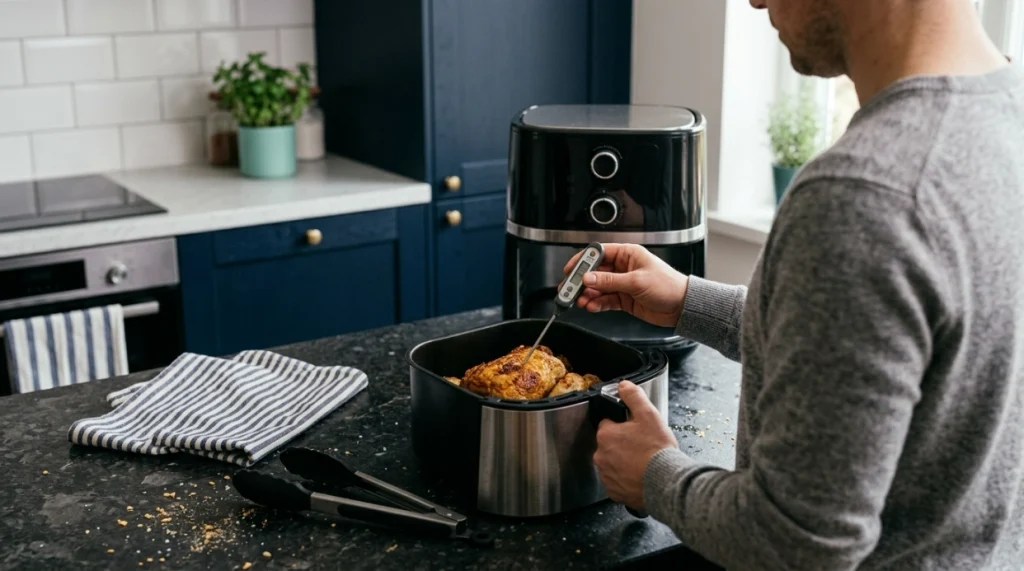
Safe air frying comes down to controlling heat, keeping the appliance clean, protecting its cooking surfaces, and checking that food is fully cooked. These habits solve most of the practical problems I see.
1. Give the air fryer room to vent
Hot air leaves through the appliance’s exhaust. Don’t press that vent against a wall, curtain, paper towel roll, electrical cord, or another heat-sensitive object.
Consumer Reports’ air fryer safety testing found that some exterior areas and rear vents can become hot enough to cause burns, so clearance and careful handling matter.
2. Don’t overcrowd the basket
Overcrowding blocks airflow and can create uneven cooking. That’s mostly a quality problem with vegetables, but it can become a food-safety problem with raw meat.
Cook in smaller batches when necessary. Turn or rearrange food if your appliance manual recommends it.
3. Use a thermometer for raw meat
Brown color isn’t a dependable measure of food safety. Check the thickest part with an instant-read thermometer.
- Poultry: 165°F (74°C)
- Ground meat: 160°F (71°C)
- Whole beef, pork, lamb, and veal cuts: 145°F (63°C), followed by the appropriate rest time
- Fish: 145°F (63°C), or follow applicable official doneness guidance
Pro tip: Use the current FoodSafety.gov safe minimum internal temperature chart rather than relying on an air fryer recipe’s cooking time alone.
4. Keep grease and crumbs under control
Let the appliance cool before cleaning it. Wash removable parts as directed and periodically check areas where grease can accumulate.
Old residue can smoke and create unpleasant odors. It can also change how the next batch tastes.
5. Don’t push every food to maximum temperature
More heat isn’t automatically better. Start with the temperature recommended for the recipe or your appliance, then adjust only when needed.
For baking, I often prefer a moderate setting because a strong top-mounted heating element can brown cakes or pastries before the center finishes.
6. Replace damaged components
A warped basket, damaged electrical cord, failing latch, peeling coating, or unusual burning smell deserves attention. Stop using the appliance if you suspect an electrical or mechanical fault.
Check the manufacturer’s support information and current product recalls when something appears abnormal.
Section Takeaway: Control browning, maintain airflow, clean grease residue, protect the basket, and verify the internal temperature of raw foods. Those steps matter more than fearing the air-frying technology itself.
Air Fryer Health and Safety FAQs
Is it unhealthy to use an air fryer every day?
Using an air fryer daily isn’t automatically unhealthy. What matters more is what you cook, how darkly you brown it, how much oil and sodium the food contains, and whether your overall diet includes plenty of minimally processed foods.
Can air fryers cause cancer?
There is no good evidence showing that normal air fryer use itself causes cancer. High-temperature cooking can form acrylamide in some starchy foods, but human studies have not consistently linked dietary acrylamide exposure with cancer risk.
Are air fryer fumes toxic?
Air frying can release particles and volatile compounds, particularly when cooking fatty foods or burning old grease. Research on exact exposure levels is still developing, so good kitchen ventilation and regular cleaning are sensible precautions.
Is an air fryer safer than deep frying?
Air frying avoids handling a large container of extremely hot oil and usually requires much less added fat. However, the appliance still has hot surfaces, a powerful heating element, and an exhaust vent that can cause burns if handled carelessly.
Should I stop using an air fryer if the coating is scratched?
A tiny cosmetic mark isn’t the same as extensive coating failure, but peeling, blistering, or flaking deserves attention. I would stop using a severely damaged basket and contact the manufacturer about a replacement rather than continuing to scrape or cook on it.
Does air frying destroy nutrients?
Heat can reduce some heat-sensitive nutrients regardless of whether you roast, bake, boil, or air fry. The effect depends on the food, temperature, and cooking time, so it isn’t accurate to say that air frying simply “destroys all nutrients.”
What is the healthiest way to use an air fryer?
Use it mainly for vegetables, potatoes, fish, beans, lean proteins, and homemade foods rather than relying only on frozen snacks. Avoid excessive browning, use modest oil, keep the basket clean, ventilate the kitchen, and verify safe temperatures for raw animal foods.
The bottom line: I wouldn’t avoid an air fryer because of broad claims that it is inherently toxic or cancer-causing. I would use it as I use an oven: control the heat, don’t burn food, keep cooking surfaces in good condition, ventilate the kitchen, and cook raw foods safely.
If your goal is a crisp result with less added oil than deep frying, an air fryer can be a practical tool. Healthy results still start with the ingredients you put inside it.
